
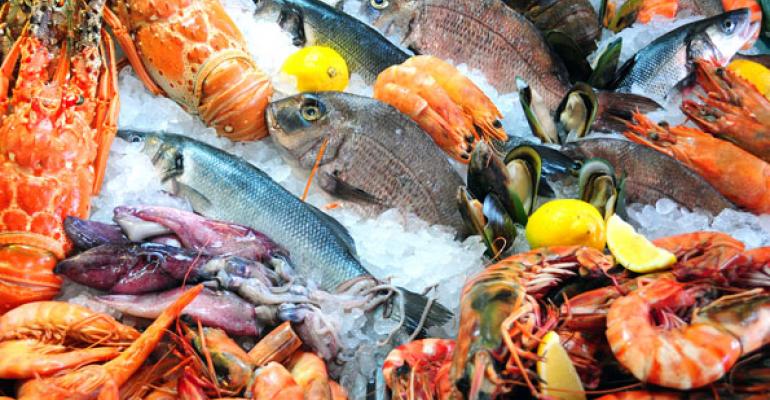
WESTBOROUGH, Mass. — BJ’s Wholesale Club here last week announced a new sustainable seafood policy that will ensure that all seafood products sold in the company’s stores are sourced from suppliers identified as sustainable, or on track to meet sustainability standards by 2014. The program was developed in partnership with leading non-profit groups including the Sustainable Fisheries Partnership, the Marine Stewardship Council and the Global Aquaculture Alliance.
Development of the policy began in early 2010, when the company began a dialogue with these non-profits, Scott Williams, manager of product development and quality assurance for BJ’s Wholesale Club, told SN.
“We knew we weren’t the experts and we wanted to get somebody who was,” he said, noting that BJ’s has since worked most extensively with the Sustainable Fisheries Partnership.
The new policy will affect all of the company’s seafood suppliers, who will be required to implement fishing and harvesting methods that protect aquatic species and ocean habitats. For example, with wild-caught fish, new guidelines help ensure that the fish are legally caught and that suppliers have remained within their catch quotas for that species. And, aquaculture operations will be required to limit their use of chemicals and implement safeguards that prevent farmed fish from escaping or otherwise affecting wild fish populations.
The guidelines also encourage suppliers and fisheries to maintain and use the latest technology to make harvesting less destructive to ocean habitats and to other aquatic species, such as dolphins and turtles.
The motivation for developing the policy was two-fold, Williams said.
“One was supply. It’s the last [commercially] hunted protein out there. So, we had to look around and see how we could supply a large volume” in the long term, he said. Second, “we were starting to see that a lot of our suppliers were doing good things. But we wanted to figure out what the message was that we wanted to send out as a retailer. We wanted to build our own sustainability policy.”
As the policy is implemented during the next two years, Williams said that club members will be able to learn more about these standards via links on the company’s web site and social media sites. In-store signage will also include QR codes to help shoppers access that information with smartphones. But this isn’t a marketing program. The goal of these low-key efforts is to provide easy access to as much information as a customer wants to know.
“The primary thing that we’re doing is what we call ‘choice editing,’” he said. “That means that everything we offer will meet our sustainability guidelines. The customer won’t need a scorecard. They’ll know, if it’s on our shelves, it’s meeting those guidelines.”
BJ’s Wholesale Club has already implemented several quality and sustainability enhancements to its seafood program, “including DNA testing on all fresh and frozen fish, chemical free seafood that does not include artificial ingredients including sodium tripolyphosphate which is often used to retain water in shrimp, and moving tilapia production to a modern farm that meets GAA standards. Additionally, all canned fish sold at BJ’s are required to comply with the International Sustainability Foundation Guidelines,” the company explained in a release last week.
Supervalu Expands Sustainability
MINNEAPOLIS — Supervalu here has announced a significant expansion of its existing seafood sustainability program, including a new comprehensive procurement policy developed in partnership with the Global Aquaculture Alliance.
Through the agreement, the company’s procurement policy will adopt Best Aquaculture Practices certification standards. Supervalu’s goal is to work closely with GAA and their suppliers to ensure that all farm-raised products sold by Supervalu and its banners are BAP certified to the farm level by early 2013, according to a press release.
“With this new agreement, Supervalu is fully committed to sustainable sourcing practices for both wild-caught and farm-raised seafood,” Chris Hooks, Supervalu’s vice president of meat, seafood, dairy and frozen foods, said in the release. “When combined with our decision to discontinue six unsustainable seafood species from our stores, our customers can be confident that we are doing our part to ensure a viable seafood supply both now and in the future.”
The six species of wild-caught fish that were discontinued due to sustainability concerns last week included orange roughy, shark, monk, bluefin tuna, skates, and hoki. The sustainability program is in effect at all Supervalu banners, including Acme, Albertsons, Cub Foods, Farm Fresh, Hornbacher’s, Jewel-Osco, Shaw’s/Star Market, Shop ‘n Save and Shoppers Food & Pharmacy.
FMI to Provide New Seafood Sustainability Tool Kit
BOSTON — The Food Marketing Institute will be releasing a seafood sustainability toolkit highlighting the experiences of 14 retailers, two suppliers and one NGO, Jeanne von Zastrow, senior director of sustainability and industry relations at FMI, announced here during a panel at the International Boston Seafood Show last week.
The toolkit — which will include guidelines, checklists and best practices — will be formally introduced at the FMI 2012 convention in Dallas on May 1 at the Sustainability Solutions Center on the expo floor, and will be available on FMI.org.
“We decided to make it free to everyone because we think that’s in the best interest in moving sustainable seafood forward faster,” von Zastrow told SN.
The report is intended to help retailers learn from other retailer’s experiences.
This toolkit could come in handy, because 90% of surveyed FMI members are working on or have a policy on sustainable seafood, von Zastrow said at the conference.
Ahold USA is one of the retailers featured in the FMI report, and its Seafood Procurement Manager Tracy Taylor spoke at the conference about the company’s experience developing and rolling out a sustainable seafood program.
Educating both customers and in-store associates about sustainability can be a difficult task, and Taylor said Ahold developed a playbook that could be downloaded and printed out by stores to keep behind the seafood counter to make associates more comfortable talking about sustainability.
“Just basically giving our associates a chance to understand why is this important, what are some of the things that we’ve done, what sort of information or some of the key items that [we] sell that consumers may ask about,” said Taylor, who is also the chair of FMI’s Seafood Sustainability Committee.
Ahold makes sustainability information available to consumers who may be confused by the different aspects of programs.
“We’ve got information available on our website. We’ve got a brochure available in many of our stores.”
Raley’s Meat and Seafood Buyer Mike Loftus discussed approaching Raley’s management about the importance of a sustainability program, despite increased costs for the chain.
“It’s the right thing to do, and if we don’t do it now we’re going to be way behind,” he explained.
For in-store training, Loftus said he spoke to managers about the Marine Stewardship Council and Best Aquaculture Practices.
“Then I put them through MSC chain of custody and the audits that go with that.”
Trips to Seafood Departments Declined in 2011
BOSTON — High retail prices have made it a tough year for volume sales in most fresh food categories.
“Consumers were basically making fewer trips that included … fresh food items in their basket,” Executive Vice President of Nielsen Perishables Group Steve Lutz said during a presentation here at the International Boston Seafood Show last week.
In 2011, seafood volume was actually hit the hardest, Lutz said, adding that a large portion of lost sales was due to customer’s substituting for other, cheaper items.
Shoppers only made an average of five trips to the seafood department in 2011, compared with 31 trips to the produce department, 25 to the meat department, 15 to the deli and 12 to the bakery, according to Lutz.
With other proteins, Lutz said customers tend to plan ahead and pick up multiple items, but that’s not the case with seafood.
Only 10% of customers make multiple seafood purchases at one time, while 43% of shoppers bought multiple produce items per trip, and 30% of shoppers picked up multiple meat department items.
On top of higher retail prices, there were fewer circular feature ads for seafood in 2011, the depth of discounts was down, and thus volume sold on promotion was down as well.
But it wasn’t all bad news for seafood in 2011. Lutz called seafood shoppers “fabulous for retailers” due to the fact seafood shoppers tend to be bigger spenders than average shoppers. Seafood customers’ average grocery trip rang up to $76.40, while the overall average basket for all shoppers’ trips was only $37.62 in 2011.
“It is the customer that a retailer really wants to cater to,” Lutz said.
And, seafood meals were one of the categories that showed growth in 2011.
“It’s a small category, but you’ve got huge numbers of new products that are surging in there, and they’re driving growth.”
In the deli department, too, seafood meals were doing well with seafood entrees up 18% in sales, sushi trays up 11% and seafood wraps up 19%.
In order to gain more sales in the seafood department, retailers might reevaluate the kinds of products they are offering.
“Seafood managers are really good at understanding what they sold last, not what they could sell next if they did it differently,” Lutz said.


