
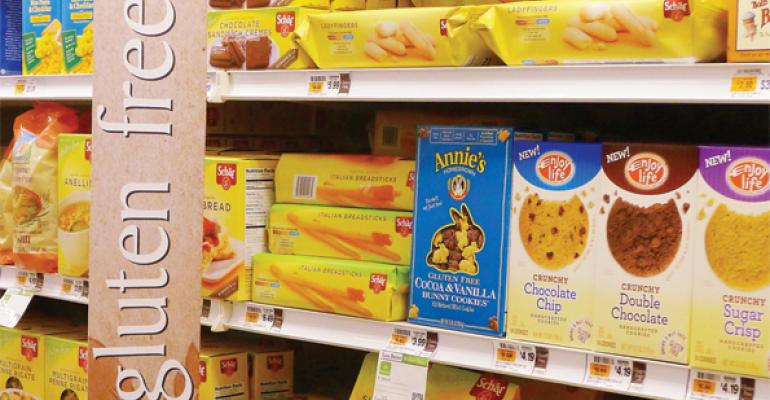
Emerging categories often benefit from special treatment as they’re introduced to consumers. Segregated merchandising creates a destination that makes it easier for shoppers to find, and for staff to notice and approach anyone lingering at the display. Clustering also helps visibly demonstrate the retailer’s early commitment to the products.
Recent history shows how segregated merchandising helped certified organic get off the ground; sales of ethnic products grouped by country have also benefited from their own section. Separation has also help certain gourmet foods find success.
Yet there comes a time when, as consumers grow more familiar with the products, priorities shift. In organic’s case, growing comfort levels allowed retailers to begin integrating products throughout the store so that shoppers could compare labels and prices.
Has the gluten-free category reached such a tipping point? The numbers would indicate it has: Gluten-free sales are approaching $6.5 billion; nearly a quarter of the shopping public has at least tried gluten-free foods; and the category has grown 30% through 2010.
At Highland Park Market, Glastonbury, Conn., the size of the store dictates how and where gluten-free is shelved. According to Tim Cummiskey, store manager for the upscale chain, integration would be ideal. But it’s not an option for all items.
“It’s a problem of space. We get so many requests for gluten-free products that we couldn’t possibly put each one within its category without having to reset the entire store,” he said. “We can squeeze a few things in here and there, but not enough to fully integrate them everywhere.”
Where there is room, Cummiskey creates miniature sections within each category. These small sets sometimes include two or three items at most. Shelf talkers donated by vendors are used to draw attention to any wheat-free fare.
REFRESH blog: The Evolving Science Behind Gluten-Free
According to Jon Hauptman, a partner at Willard Bishop, the Barrington, Ill.-based retail consulting group, retailers benefit most when integrating within categories.
“This is the option we recommend,” said Hauptman. “By stocking gluten-free products together alongside other standard varieties, supermarkets enhance their variety image, simplify the shopping process and highlight targeted items. Based on our analysis of specialty food merchandising — gourmet, natural, organic and now, gluten-free — having adjacent sections significantly increases sales of the special items as well as total category sales and profits.”
The firm’s studies reveal that integration can increase sales of the targeted items by an average of 40%. Category sales grow by an average of 12% and category profits by an average of 15%.
Merchandising Gluten-Free
The key is to highlight the products with special in-line fixtures, said Hauptman. He cited metro racks, four-foot curved gondola shelves, front-of-shelf strips and blades that frame the special offerings as examples of merchandising materials supermarkets should consider.
Dayton, Ohio-based Dorothy Lane Market had a single celiac disease-centric space in every store years ago. Today, the supermarket subscribes to Hauptman’s subsection strategy.
“Over the past 15 years, we have integrated products throughout the store until we no longer had a dedicated gluten-free section,” said Tom Winter, the independent retailer’s vice president of marketing. “We regularly check movement of all gluten-free SKUs and only stock three to four wheat-free or GF products in each category. We taste test every gluten-free product in-house to determine which ones to carry.”
Gluten-free products at Dorothy Lane are called out with shelf talkers, perpendicular circles and frames in every department where present. The three-store chain also hosts gluten-free vendor events with multiple manufacturers on-site offering samples of the products sold in the store. Vendors and store employees are on hand to direct shoppers to the exact location of each product within various departments.
The category has grown to the point where shoppers don’t want to be inconvenienced having to visit multiple places in the store — one spot for gluten-free and another for standard varieties, said Jim Wisner, president of Wisner Marketing Group, Libertyville, Ill.
“Far too many supermarkets still have gluten-free sections with everything from pasta to snacks,” he said. “This would be wonderful if the 30 or so products stocked there are the only things the person eats and if everyone in that household consumes GF exclusively. But this is rarely the case.”
Wisner believes that retailers without integrated merchandising programs for gluten-free could eventually lose market share to those who cater to customers’ needs for convenience.
Maria Brous, spokesperson for Lakeland, Fla.-based Publix Super Markets, disagrees, citing reasons why a dedicated section makes sense. For one, shoppers stopping by segregated gluten-free sections are there for a reason and therefore are more likely to notice unique items that would get lost in the sea of sundries stocked elsewhere.
These sections can also help the retailer analyze its gluten-free offerings, testing them before deciding to make room in other parts of the store, she said.
Read more: Supermarkets Become Gluten-Free Guides
“We have been actively seeking and adding gluten-free items for our customers and in many cases, we pick up lower-volume items that cannot maintain their place in the regular section, but sell well in a gluten-free area,” said Brous. “And, as the products in our GF section become more mainstream, we try to integrate them into their traditional product sections.”
While many supermarkets have drawn a parallel between merchandising strategies applied to organics and gluten-free goods, Highland Park’s Cummiskey points out a major difference.
“People choose to eat organic, but shoppers with celiac disease don’t have much of a choice,” he said. “If we don’t carry enough GF products and don’t merchandise them in a way that meets all the needs of our customers with gluten issues, they will go somewhere else to make their purchases.”
Sidebar: Two Issues
Integration might be the most effective method of merchandising gluten-free, but each retailer needs to consider several factors, and mind the desires of their customers. Jim Wisner, president of the Wisner Marketing Group, suggested that before deciding, retailers and store managers should consider two issues.
“The biggest thing retailers need to remember is that they have to make the products easy to find, whether they are standard or specialty items like gluten-free,” he said. “They should also keep in mind that people with special dietary needs search for product information so efforts should be made on websites and in stores to showcase what gluten-free items a chain carries and where to find them.
| Suggested Categories | More from Supermarketnews |

|
|
|
|
|

|
|

