
NEW YORK — Investors clearly rewarded the best-managed food retailers in 2011, according to analysts, as chains like Whole Foods Market, Ruddick Corp., Costco Wholesale and Kroger Co. all saw stock-price gains that exceeded the market.
Companies that lost market share in 2011 or struggled to hang onto share, such as Supervalu and Nash Finch Co., saw double-digit declines in their share prices.
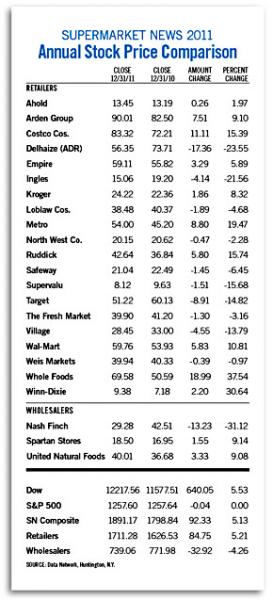
To some extent the performance of the “big three” traditional supermarket companies — Safeway, Kroger and Supervalu — reflected how the market viewed the supermarket sector in 2011. Kroger saw gains in market share and earnings and a corresponding rise in stock value (up 8.32% for the year); Safeway struggled to hang onto market share and saw its share-price slide (down 6.45%); and Supervalu lost market share and suffered a share-price plunge of 15.68% in 2011.
 “Kroger is the only one that’s had a little bit of market share gain and a little bit of earnings gain, and it’s being rewarded for that,” said Andrew Wolf (right), a Richmond, Va.-based analyst with BB&T Capital Markets. “Kroger’s quarterly earnings are a little erratic, and they get punished for that, but overall their execution has proven to be good.”
The outlook for the current year appears somewhat brighter for the industry as a whole, analysts said, providing the economy continues to show signs of improvement and inflation remains manageable.
“2012 probably should be a better year for food retailing, primarily because of product costs, which should abate, and if the economy continues to improve,” said Wolf. “It’s not a great environment, but it is better than we have seen in the last couple of years. We could end up with nominally positive same-store sales [in the industry], and gross margins could be slightly better.”
 Karen Short (left), a New York-based analyst with BMO Capital Markets, noted that gas prices “could be a wild card” in 2012, but overall, “It doesn’t appear there is any reason to think the environment will get any worse for any of these retailers.”
The sharp inflationary and deflationary periods of the preceding years made for a much more difficult operating environment, analysts noted. In 2011, although moderate inflation returned, the potential benefit was dampened at many retailers because of weakness in consumer spending power, at least for retailers serving middle- and lower-income households.
Retailers at the high end — such as Whole Foods and Ruddick Corp.’s Harris Teeter chain — enjoyed the benefit of strong spending among the highest earners, which the companies were able to leverage to their benefit through their own strong operational expertise, analysts pointed out.
“It was pretty much an ideal environment for the supermarkets that primarily sell to the top quarter in income,” said Wolf. “The upper quarter of earners were spending normally, as in a normal economic recovery.
 “For those retailers, primary demand was excellent, volume was excellent, and they also had pricing power, so they were able to pass along inflation. That’s about as good as it gets for a food retailer, to have strong primary demand and to have pricing power.
“For everyone else, the demand conditions were challenging.”
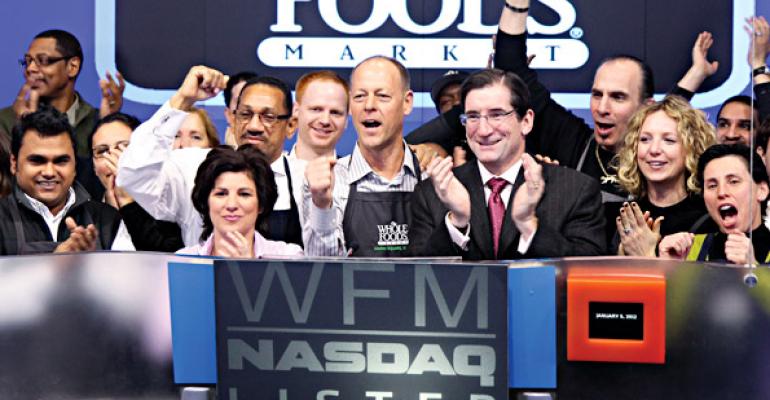
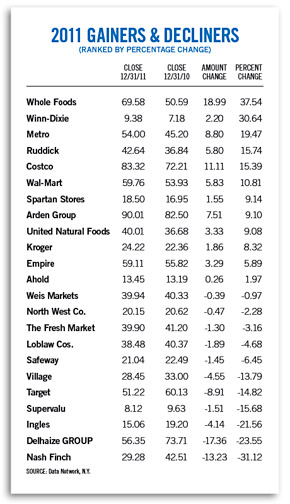
Austin, Texas-based Whole Foods Market — one of the top stock performers for the last three years — again led the pack in 2011, with a share-price gain of 37.54%. Matthews, N.C.-based Ruddick Corp. was not far behind on the list of top gainers with a share-price increase of 15.74%.
Other gainers included Winn-Dixie Stores, Jacksonville, Fla., up 30.64% following its agreement to be acquired by privately owned Bi-Lo; Montreal-based Metro Inc., up 19.47%; and Issaquah, Wash.-based Costco Wholesale, up 15.39%.
Overall the 23 North American food retailing stocks tracked by SN performed in line with the Dow Jones Industrial Average, and outperformed the S&P 500 Index. The SN Composite Index, a weighted measure compiled for SN by Huntington, N.Y.-based Data Network, rose 5.13% for the year, vs. 5.53% for the DJIA and a flat performance by the S&P 500.
In addition to enjoying the benefits of high spending by top-income households, Whole Foods also managed to keep its operating costs in check, particularly store-level labor, Wolf pointed out.
“One thing they did that helped their earnings is they took their labor rates down a lot — down almost 25% in the last two years,” he said. “Their labor productivity shot through the roof.”
In addition, the company has had success battling its longstanding image as being high-priced, Wolf said, primarily through the use of traditional means such as coupons and price specials.
“Whole Foods is just doing a lot of things right, and one of the things is that their value image is much better than it was,” he explained.
Short agreed that Whole Foods benefited both from strong management and the spending power of its target demographic.
Although she said she thinks the company’s stock could be “flattish” in the near term, she is optimistic on its performance going forward, given the company’s strong fundamentals and other factors. “It’s very hard not to like that story,” she said.
Harris Teeter Gains
Similarly, Ruddick Corp. presents a strong rationale for investors, she explained.
“Ruddick’s comps were very strong, and as usual they managed their business extremely effectively,” Short explained, noting that the company generated strong EBITDA growth in its first three fiscal quarters.
 “When you look at Harris Teeter, they have positive free cash flow, unit growth, a decent valuation — a lot of metrics that are very favorable for investors. Sometimes investors on the surface can look at Harris Teeter and say, why should it trade at a premium to Kroger, but they have a lot of things that make it attractive.”
Wolf agreed that Ruddick — which is seeking to change its corporate name to Harris Teeter now that it has sold its thread business — remains an attractive stock.
“They are a very highly valued franchise in the eye of the consumer,” he said. “The consumer knows they are paying more at Harris Teeter, but they are willing to — it’s a question of whether the economy will support the consumer going to the supermarket they prefer. So, they have a lot of leverage with an economic recovery.”
He noted that the chain could be seeing some competitive pressures from Food Lion, which is in the process of rolling out a market-by-market makeover, although Harris Teeter appears to be managing well to retain its market share.
Safeway A Puzzle
Pleasanton, Calif.-based Safeway, however, continues to puzzle analysts as to why it underperforms its peers, given its skew toward higher-income demographics.
“I think the problem Safeway is having is that maybe customer loyalty isn’t as strong as one might have hoped, and that could be related to the complexity of their pricing,” said Short, noting that apparent shelf prices can sometimes obscure the benefits of loyalty programs. “The complexity of their pricing leads to less transparency and to a perception that prices are higher.
“When Safeway says their prices are in line with competitors, I tend to believe them — I’m just not sure the customer understands that.”
Weighing in Safeway’s favor, however, is the fact that volumes have stabilized and the company has committed to repurchase shares in the first quarter — a move that could shore up the share price.
Minneapolis-based Supervalu, by contrast, has not yet stabilized its volumes, although analysts noted that it has been making progress.
“Relative to Safeway, Supervalu is in a ditch,” said Wolf. “Safeway has now reached market-share neutrality, and Kroger is gaining share, but Supervalu is still losing share.
“They need to continue to run the business better, and focus on pricing and their value image. Management there has done a very good job with the hand they have been dealt — what they inherited was not functioning properly and was very complex.”
Losing market share, Wolf said, “is not a strategy that can be maintained. Other than in a booming M&A environment, it’s a bad strategy for investors. They are really playing catch-up pretty quickly, but it has to manifest itself in gaining market share to have a positive impact on market value.”
Short agreed that Supervalu has its work cut out for it in 2012.
“Companies that have maintained a pattern of declining traffic for an extended period of time are not going to get that traffic back, no matter how hard they work to improve performance in the store or the experience inside the store,” she said.
UNFI, Spartan Gain
Other stocks that performed above the average for the industry for the year included wholesaler United Natural Foods Inc., which saw top-line benefits from the incorporation of specialty foods into its mix and the ensuing addition of more traditional supermarket customers.
“Sales were extraordinarily good, so their strategy of getting into the specialty product area was a good decision,” said Wolf. “In 2012 their sales should continue to grow, so it could be a big year.”
Grand Rapids, Mich.-based Spartan Stores was a bit of an exception to the market-share rule, as its stock saw gains of 9.14% despite its struggles to drive traffic gains.
“Spartan saw negative traffic trends, but not worse than the market as a whole,” Short explained. “So on a relative basis, Spartan wasn’t really losing share, which is why their stock kind of hung in there. Spartan also is maintaining its profitability.”

