
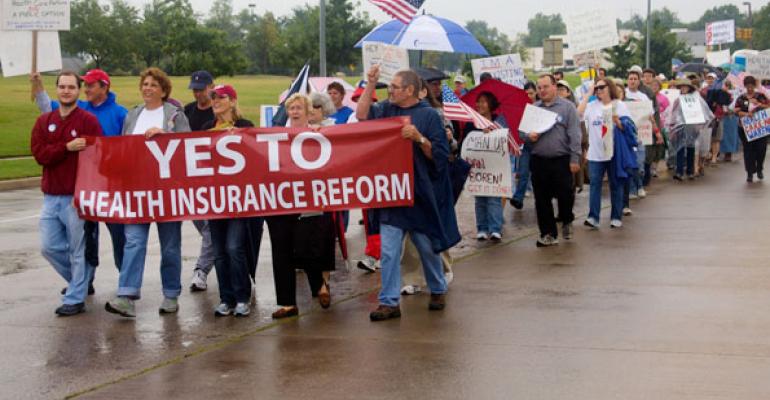
WASHINGTON — The U.S. Supreme Court’s decision to uphold the Patient Protection and Affordable Care Act brought some degree of closure for retailers and their workers, but at the same time left room for a range of outcomes that the industry will seek to shape.
National retail associations — including Food Marketing Institute and National Grocers Association — last week said they would continue to try to influence through regulatory and legislative channels how the health care overhaul will impact their members’ businesses.
 “With this decision, NGA will redouble its efforts to minimize the impact and burdens on independent retail grocers by continuing to work closely with fellow members of the Employers for Flexibility in Healthcare Coalition to educate the administration on the important need for maximum flexibility in regulatory requirements,” said Peter Larkin, president and chief executive officer, NGA.
He added that NGA “supports health care reform that increases competition in the marketplace and reduces costs on employers.”
The sweeping law will require all Americans to have insurance or else pay a penalty, and it also will mandate and place new parameters on the coverage of workers by their employers, effective at the start of 2014.
Among the areas of concern for retailers is how the law will define full-time employees for the purpose of determining eligibility for coverage. FMI has argued that employers should be able to “look back” at a full year of an employee’s hours to account for seasonality and fluctuations, rather than a shorter time period. The association also said it supports a change in the definition of “full-time” to mean 35 hours per week, vs. 30.
In addition, the regulatory authorities will need to set the parameters that define the coverage that retailers provide, including the “affordability” of the plans and “minimum value” of the coverage. The law requires that an employee’s contribution to a plan’s premium should not exceed 9.5% of their household income, and FMI is seeking to have that measured against the employee’s current wages instead. In addition, FMI said the scope of the plans should be limited to coverage of 60% of the estimated costs of the benefits, rather than dictate what specific benefits are offered.
Retailer Concerns
Retailers are also concerned about auto-enrolment — the automatic addition of employees to an employer’s plan, which FMI said could result in “double coverage” if someone is already covered by another plan.
Other aspects of the PPACA that impact food retailers include a requirement that retailers label the calorie counts on prepared foods in the same manner as restaurants, which both FMI and NGA said was not the original intent. Another aspect of the law restricts consumers from using their pre-paid flexible spending accounts on OTC medications without a prescription. Retailers are seeking to allow such spending without a prescription.
 “As employers of millions of full-time, part-time and seasonal workers, uncertainty still remains for food retailers in every community in this country,” said Leslie G. Sarasin, president and chief executive officer, FMI. “Within the coming 18 months, federal agencies must issue new regulations covering all of these issues and more, and each company across the industry will be forced to decide how best to adjust its health coverage and work schedules, to comply with the new law — or whether to simply withdraw from offering coverage and pay any penalties that may be required.”
Jennifer Hatcher, senior vice president, government and public affairs, FMI, told SN that the law will be an “enormous burden” for retailers, but now at least retail groups can devote their resources to lobbying for the caveats and exemptions they are seeking.
“We’ve been in a holding pattern for the first two years and three months since the first lawsuits were filed,” she noted. “When you have something as enormous and impactful as this, waiting for information and guidance just to see what’s possible has been frustrating for our members.”
She said FMI would continue to work with the regulatory agencies that have responsibility for promulgating the rules that will ultimately shape the law — the Departments of Treasury, Health and Human Services, and Labor — as well as with members of Congress who are seeking to influence aspects of the law through legislation.
“We’ve been working on those two tracks all along, but when you had the Supreme Court decision on the judicial side looming over this, it’s been difficult to get as much progress as we needed,” Hatcher said.
Burt Flickinger, managing director, Strategic Resource Group, New York, who consults on labor contracts, said the law could be a “competitive concern” for traditional supermarket retailers relative to employers like Target Corp. and Wal-Mart Stores that employ more part-time workers.


