
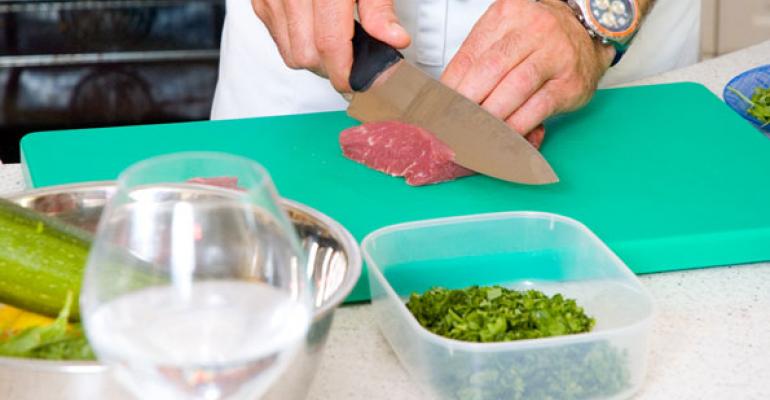
ORLANDO, Fla. — The preparation techniques that shoppers use to cook meat and poultry at home have changed a lot during the past five years, according to consumer research in the seventh annual Power of Meat study, presented here at the 2012 Annual Meat Conference, a joint production of the American Meat Institute and the Food Marketing Institute.
Most notably, frying meat and poultry at home declined 22% during the past five years, while 12% of shoppers say they are using crock pots/slow cookers more often. An additional 12% said that they are using ovens to prepare meats more often.
Stir frying held steady, with a 0% change, while indoor grilling and outdoor grilling declined by 3% and 1%, respectively.
Presenter Michael Uetz, principal of Chicago-based Midan Marketing, noted that there may be a couple of reasons for these shifts. Shoppers may have acquired a negative health perception regarding frying, for example. And, oven and slow cooker preparation may be on the rise because these methods are typically used for cuts that offer more value per pound.
“When you think about price and value, you can get a lot of extension out of a bigger product that you put in the oven or slow cooker,” Uetz explained. “You can make a whole meal in a slow cooker. It tends to be a lower-priced product.”
Uetz encouraged attendees and others to consider this shift when developing recipes or offering preparation suggestions, but added that “a lot of shoppers don’t have a clue — especially our younger shoppers — about what to do with these cooking methods. You’ve got to talk to them.”
Survey respondents of all ages said that there was lots of room for improvement with their cooking skills. When researchers asked how comfortable they were with preparing different items, 56% said they needed help figuring out how to prepare fresh poultry. Almost 60% said they needed help with meat, 63% needed advice for using marinades and spices, 65% said they were unsure how to cook seafood, and 73% said they were unclear about the terms used in the U.S. Department of Agriculture’s beef grading system.
When these customers seek cooking advice, they tend to turn first to family and friends, then to digital resources, such as smartphone apps or the Internet.
“Thirty-percent say that they are asking mom, family and friends,” particularly younger shoppers, Uetz said. “Only 6% are asking someone in the meat department for advice.”
This presents a big opportunity for meat departments, Uetz said.
“When we asked them ‘if we were to give you more information, can we play a bigger role?’ 30% said ‘absolutely’ … and another 53% said that on occasion they would use that information. It all goes back to [how] we’ve got to communicate, we’ve got to educate.”
Performance of Dietitians Measurable in Many Ways
Registered dietitians have become a familiar sight in the supermarket industry, teaching courses on nutrition, offering store tours to customers with special dietary needs and developing community outreach programs. These professionals have assumed an especially prominent role at Hy-Vee, which currently employs a full-time RD at almost every one of its 235 locations.
When the company first began placing dietitians at the store level, a lot of store directors had questions, and were unsure about how to measure performance for these new employees, Kara Behlke, a registered dietitian for Hy-Vee’s Marion, Iowa location, explained at the Meat Conference.
“When we first started off, a lot of people [within the company] didn’t know what a dietitian did, but they’re beginning to figure it out,” Behlke said.
Behlke noted that there were several specific metrics that stores could use for RDs, measuring their number of customer consultations, media impressions, store tours and demos hosted per month, for example.
Behlke also has her own UPC code that is used to track paid one-on-one nutrition counseling sessions or community presentations. And, when hosting events, she gives attendees coupons and tracks their usage.
In addition, she suggested using a tablet computer or laptop to get instant feedback during recipe or product demos. Free online services, such as surveymonkey.com, make it easy to learn what customers are thinking.
“Ask your customers what they want, and they will tell you,” Behlke said.
One of the most popular events that Behlke has hosted at the Marion location is a “Cooking With a Cardiologist” event, in which Behlke teams up with a local doctor to teach heart-healthy recipes. The event regularly draws the maximum of 60 paid attendees. A Halloween fun night featuring games and activities for kids in every department has also grown every year.


