
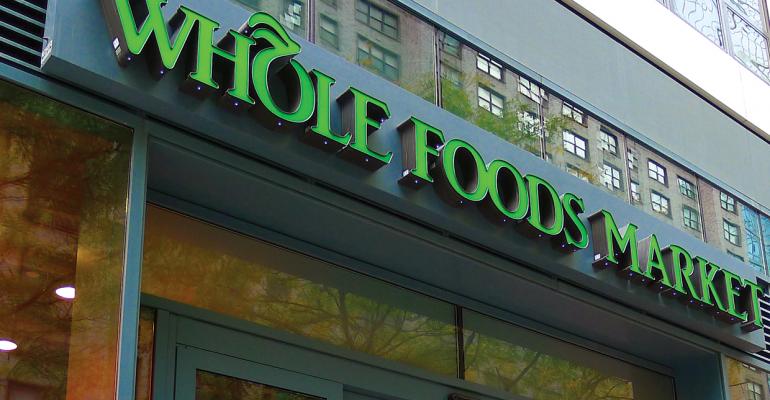
For Whole Foods Market, smaller stores in smaller markets are proving to be better — and just as profitable — industry observers told SN.
The Austin, Texas-based chain has developed a smaller footprint that enables it to expand aggressively into more mid-sized markets — like Des Moines (population 570,000); Wichita, Kan. (350,000); and Lincoln, Neb. (250,000) — while maintaining comparable rates of return as it strives to meet its goal of 1,000 stores over the next decade.
According to Walter E. Robb, co-chief executive officer, “I’m confident we can achieve our 1,000-store goal. The question will be how quickly can we go? Right now we’ve put [out] numbers for the next three years, and we’ll see if maybe we can go a little bit faster.”

Whole Foods opened approximately 25 stores in the fiscal year that ended Sept. 30 to finish the year with 340 units, and it plans to open 28 to 32 more in 2013 and 33 to 38 in 2014. “And with 12 operating regions and the infrastructure we have right now, we could easily do up to 50 stores a year,” Robb said in a presentation in July.
Still, the company remains “significantly underpenetrated,” Kate Wendt, senior analyst with Wells Fargo Securities, San Francisco, said, though annual expansion will nearly double within the next two years to annual square footage growth of 9.5%, compared with 5% in fiscal 2011, she pointed out.
“And that growth should be sustainable,” she added, due to three factors: the continuing shift in demand toward natural and organic products; the chain’s efforts to improve its value proposition; and the continued tailwind of share gains from traditional grocery.
Whole Foods’ growth vehicle of choice is a store of 38,000 square feet to 40,000 square feet, rather than the 50,000-square-foot prototype it was building five years ago. According to John Mackey, chairman and co-CEO, the smaller boxes “are less complex to design, build and open.”
 Whole Foods began looking more seriously at expanding into smaller cities after its 2007 acquisition of Wild Oats Markets, which was operating smaller stores in smaller cities than Whole Foods. That insight, plus the economic realities of the recession, prompted the company to shift its real-estate strategy “to get the right-sized store into the right community,” Robb explained, “and we have just begun to scratch the surface of what we potentially can do.”
According to Wendt, the flexibility Whole Foods has built into its new-store development program makes broader expansion possible, along with the ability to size each store differently, depending on the market — a combination that has enabled the company to achieve the same returns in the smaller footprint as larger stores produce, due to lower capital and lease requirements, she pointed out.
 “Whole Foods realized during the recession that not only did it not need such large stores in many markets but also that it could pare back the costs to build and fixturize them without sacrificing the customer experience,” Wendt explained.
“The result is a less glitzy store that still delights customers but with development costs that fell 22% to $248 per square foot for stores opened in 2011, compared with $316 per square foot for stores opened in 2009,” she said.
Chuck Cerankosky, an analyst with Northcoast Research, Cleveland, said the biggest plus with the smaller stores is return-on-assets, “which is management’s primary focus. “Until a few years ago Whole Foods was opening larger, more opulent stores that didn’t produce returns as quickly as it anticipated, and in some cases returns that were very disappointing.
“But the smaller stores require less investment than those stores, so if all else is right, the company ends up with more dollar profits and a more than adequate ROI.
“What’s so impressive for Whole Foods now is, the small stores are performing well and are contributing to earnings growth as effectively as the bigger stores, without getting as much volume per store but achieving close to the same sales per square foot.”
According to Robb, Whole Foods has been able to boost return-on-invested-capital to close to 15%, compared with 6% in 2007, “which has been a wonderful gain,” and to get stores “coming out of the gate much stronger than they were just three or four years ago.”
He said the 38,000-square-foot prototype is producing average weekly sales of $575,000, or $786 per square foot, with margins of just under 6%. According to Wendt, that compares with $754 per square foot in 2011 at stores averaging 39,400 square feet and $652 in 2010 at stores of 42,600 square feet.
“Whole Foods figured out it had the capability not to be forced into a one-size-fits-all strategy,” she said, “and, with that flexibility, it could not only enter new markets it had not considered before but could also achieve higher sales per square foot by developing stores that are more right-sized for each market.
“For example, it used to enter some mid-sized markets with 50,000-square-foot stores that needed a much larger volume to succeed. But the company realized it can go into similar markets with one 30,000-square-foot store and then add another if [the first one] performs well,” Wendt explained.
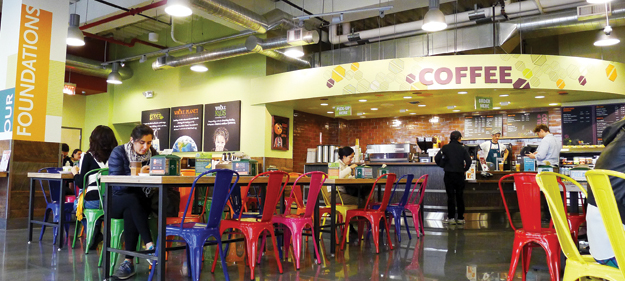
According to Jim Hertel, managing partner at Willard Bishop, Barrington, Ill., what’s lost in the smaller stores are “some of the services that have become part of the Whole Foods shopping experience,” including dine-in restaurants, cooking classes and other ancillary services.
What it loses in selling space, however, it makes up for in terms of labor efficiency and labor productivity, Hertel pointed out.
The smaller footprint also forces Whole Foods to be a sharper merchant, he added. “With less display space and with fewer aisles and fewer endcaps or open floor space, secondary display locations must be tighter.”
According to Wendt, although the reduced-size stores do not carry the same depth of selection as the larger ones, “they are still densely merchandised, which in many categories means a smaller selection of each type of product rather than removal of entire product categories.
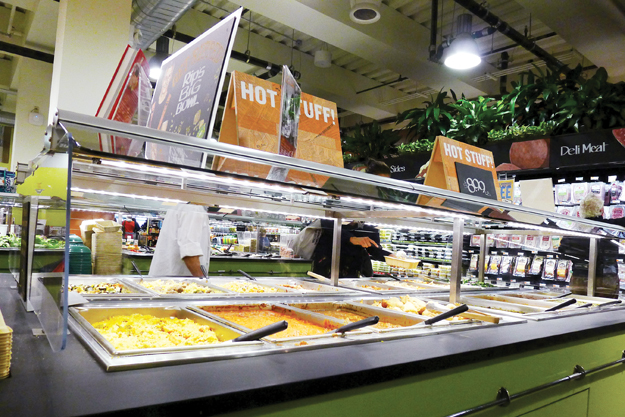
“There might be fewer prepared food stations than in other stores, but there is still typically an ample prepared foods section for each particular market,” she noted.
Andrew Wolf, managing director for BB&T Capital Markets, Richmond, Va., said he views the reduction of prepared-food offerings as a positive. “The food service sections that have been eliminated were pretty much a drag on profits because of high labor costs,” he explained. “You can’t afford to have people sitting around a barbecue pit or a panini bar, even though they may be attractive sections, because those sections are not going to give you a huge return.
Read more: Whole Foods Buys Six Boston-Area Sites
“The most profitable foodservice sections in the smaller stores are the hot foods bar and the salad bar, which are both self-service,” he pointed out.
Cerankosky said the stores still offer prepared foods, “but with less dine-in space, which was under-utilized throughout most of the day anyway. And by paring back the number of prepared food areas to two or three instead of four or five, it cuts labor costs.”
The loss of shelf space and the tighter assortment that’s required is not a big issue, he added. “Whole Foods can make the stores more convenient to customers by operating two or three small stores instead of one monstrous store, and that works well for the kind of upscale, time-pressed customer to whom it appeals.”
Cash Flow Fuels Growth
The company generates over $1 billion of cash flow through consistent execution, Robb said, “and we’re committed to funding our growth out of our own cash flow, which is pretty exciting. We have about $1.5 billion of cash now, and we’re going to use it to continue to grow faster; to keep looking at our dividend to return cash to shareholders; to consider buying back stock; to hold on to some of the cash to have a little bit of cushion; and to continue to be opportunistic, “so if an opportunity surfaces, we will have the dry powder to be able to take advantage of that.”
Robb said Whole Foods sees 50 new stores per year as a realistic goal, and the company is moving in that direction.
Observers said they don’t expect Whole Foods to make any more large acquisitions. Acquisitions are possible, Wendt noted, “though they may be more likely for real-estate purposes — to acquire good locations — than large strategic deals.”
Cerankosky said it’s possible Whole Foods could do another large acquisition, “but acquiring onesies and twosies is more likely.”
The biggest impediment to more rapid growth may simply be an inability to staff the stores with the kind of talented and skilled personnel the current store base has, Wolf pointed out.
“Whole Foods has one of the best-trained staffs of any operator, but what puts a cap on expansion is the skills of the people running its stores, particularly in terms of how they treat customers,” he said.
In the presentation last June Mackey said Whole Foods has the cash, the infrastructure and the locations to open 100 stores a year. “The limiting factor is how many stores we can open and not dilute our culture and our values,” he explained. “Could our culture integrate that growth rate right now? Probably not.”
According to Cerankosky, “Staffing the stores is a critical component of Whole Foods’ success. The company needs people who are into food and handling customers, and that’s something Whole Foods does not do casually, nor is it something it could rush if it were to expand too rapidly.”
Taking a broader view of its potential operating area, Whole Foods has begun “to spread our wings into different parts of the country,” Robb said.
During the first three quarters of the year, it opened 14 new stores — in Folsom and Laguna Niguel, Calif.; Pembroke Pines, Fla.; Kailua, Hawaii; Jamaica Plain, Mass.; Edina and Minnetonka, Minn.; Greensboro and Wilmington, N.C.; Yonkers, N.Y.; Oklahoma City; Glen Mills and Wexford, Pa.; and Lynnwood, Wash.; with future stores scheduled for Palm Desert, Calif.; Pompano Beach, Fla.; Park Ridge, Ill.; Wichita, Kan.; Columbia, Md.; Kansas City, Mo.; Lincoln, Neb.; Parsippany, N.J.; and Wynnewood, Pa., in addition to Boston, Dallas and Houston —“which speaks to the breadth and variety of market opportunities available to us in new and existing markets and urban and suburban locations,” Robb said.
The company announced earlier this month it would open a 39,000-square-foot store in mid-2015 in the Harlem section of Manhattan — a location made possible by the smaller footprint, a real estate broker said in published reports. Whole Foods had been looking for locations in the area for more than 10 years, he said “but there isn’t much large space.”
In a conference call with analysts Robb referred to the Whole Foods that open in July in Des Moines as the company’s “poster child.”
“I was talking with customers there, and what struck me was they know who we are and what we stand for, and I’m not sure that would have been true all over the country five years ago — and they know what they’re looking for in their own lives in terms of healthier living, however they define that, and they see Whole Foods as having a role to play in that.”
Speaking on the same call, James P. Sud, executive vice president, growth and business development, said the biggest surprise in Whole Foods’ recent expansion “has been how well we fit into some of the new, smaller markets we’ve entered.
“We recently signed leases in Lincoln, Neb., and Wichita, Kan., which are markets we wouldn’t have focused on probably five or six years ago. But the confidence we have entering those markets is based on the reception we’ve had in places like Des Moines and Wilmington and others.”
 Reflecting on the Wilmington entry, Kenneth J. Meyer, the chain’s executive vice president, operations, told analysts, “It’s a beach town, but we’re realizing it’s a very solid market for us to go into, and it opens the door for us to think about areas that in the past we’ve never thought about. So the success in those places is really powerful.”
Finding locations going forward should not be a problem, Wendt pointed out, particularly as other retailers experience shifts to more online sales and opt to close stores, which would open up multiple real-estate opportunities. “Companies like Whole Foods should be able to take advantage of this opportunity to accelerate growth,” she said.
Robb said he sees “nothing but growth ahead for us. We’re nowhere near our capacity, and we’re increasingly confident in our ability to support store openings. But we’re trying to make sure we can do it in a very sustainable fashion.”
According to Mackey, “None of our markets is saturated. I sometimes think we’re getting to the saturation point in some markets and then our comps there go up in double-digits, so we open another store, and it does really well.
“We’re not seeing any regions right now where we’re having to slow down growth. The great thing about the Whole Foods model with 12 distinct regions is, each has the infrastructure in place on a regional basis to grow.
“Obviously there are physical limitations or an upward limit on growth within a region, but we’re not close to that in any region. In fact, it’s just the opposite — we’re finding we’re able to open stores in some of our larger regions a lot quicker than we ever have been able to do — for example, 10 stores in the next 20 months in the Midwest.
“Right now the Midwest is our fastest-growing region. It’s just exploding. This is a region where we really struggled years ago. But that has changed, and we think the Midwest might be our largest geographical region over the next six or seven years.”
Operating with 12 regions, Whole Foods is more decentralized than most chains — an approach that works well for a natural grocer, Wendt said.
“Its unique regionalized operating model provides a ‘secret sauce’ that enables store assortments and promotions to be highly localized and more relevant to customers, which should continue to differentiate the concept from competitors.”
Read more: Whole Foods Plans Harlem Store
Cerankosky said the regional operations give Whole Foods greater pricing flexibility as it strives to change its image. “The value proposition is more apparent to consumers than it used to be, and while they understand that a seafood item, for example, may not be the cheapest around, they also understand the quality is probably better than what the competition offers.
“And while the company may be able to offer seafood products at $30 a pound in a larger, more densely populated place like New York City, it may find $24 a pound is the top price it can get in Cleveland, so it will edit its selection accordingly.”
Cerankosky said he’s not particularly concerned whether or not Whole Foods reaches its 1,000-store goal in a specific amount of time. “The chain is growing at an above-average rate and the stores are performing very well, so I’m not keeping a scorecard on how many stores there are or if it gets to only 900 locations in a number of years instead of 1,000.”
Sidebar: Whole Foods Expands Beyond the U.S.
WHOLE FOODS MARKET sees attractive growth opportunities outside the U.S. — in Canada, the United Kingdom and beyond, according to company executives.
According to Walter E. Robb, co-chief executive officer, “We have 95% of our chips in the U.S., but Canada has a 17% corporate tax rate and values as a country that are very much in alignment with ours in terms of community and the environment.
“Canada is a great place to do business, and we are doing extremely well there and we are going to continue to push there.”
John Mackey, chairman and co-CEO, said Canada represents “a billion-dollar opportunity for us.”
Whole Foods expects to open its fifth Canadian store, in Markham, just north of Toronto, in late 2013, “and we think we can open 35 or 40 stores in Canada, and maybe more,” Robb said.
The chain has stores in Vancouver and Toronto and plans to expand to Ottawa “and maybe places like Calgary, Edmonton and Montreal,” he noted.
Whole Foods opened its first store in the U.K. in 2007 in Kensington, “and I think we have finally learned some lessons from our experience there, and we have a wave of three or four more stores in development in the U.K.,” Robb said.
It relocated the Kensington store to an 18,000-square-foot space in Piccadilly Circus last May, “and to me it’s like the first time we actually have a Whole Foods-store feeling in London,” Robb said. “It took us a couple of years to get all the pieces put together, including the supply chain, and the store has been a success right out of the gate, and it’s really encouraged us to think that this store is the right size for us in London.”
Read more: Whole Foods Stock Hits All-Time High
Whole Foods has three more U.K. stores due to open, he said — in Cheltenham, Fulham and Chiswick.
Mackey said Whole Foods might expand beyond the U.S., Canada and the U.K. into a fourth country during the next decade. “But there’s not going to be any big Whole Foods march across the world because it means starting your supply chain over from scratch,” he explained.
“When you open a supermarket like Whole Foods, with 30,000 to 40,000 SKUs, you can’t just take the supply chain you have in the U.S. and transfer it to another country. You have to almost start over from scratch, so as we expand in other countries, it’s going to be a gradual creep.”
Sidebar: Smaller Stores Allow Price Investment
WHOLE FOODS MARKET has been an industry leader in terms of financial results, thanks in part to investments in its price image.
“In an economic environment that is proving difficult for many retailers, we are thriving,” Walter E. Robb, co-chief executive officer, said during an industry presentation in July.
Net earnings rose 32% to $116.8 million in the third quarter that ended July 1, while sales were up 14% to $2.7 billion, and identical-store sales increased 8% — the 10th consecutive quarter of comps of at least 8%.
In addition, transaction counts are up over 7%; basket size is up around 1%, with “meaningful” increases in baskets of $50 and more; and store productivity has improved to close to $1,000 per square foot at mature stores, “some of which is because we’ve tailored the store size down a little bit,” Robb said.
For the fiscal year that ended Sept. 30 — whose results are scheduled to be released Nov. 7 — the company is forecasting earnings growth of 16% to 17%, with earnings per share of $2.51 to $2.52 and sales up 13% to 14%; and for 2013 it expects EPS of $2.83 to $2.87, with comps up between 6.5% and 8.5%.
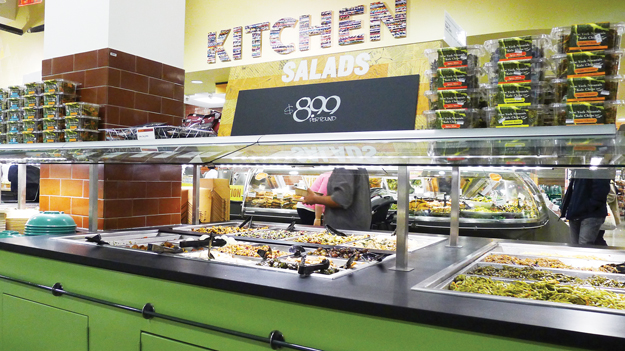
Part of Whole Foods’ success in the last few years has come from the decision to improve its pricing position, chain executives explained.
In a speech in June, John Mackey, co-CEO, said, “We’re going to continue to try to make ourselves more and more competitive on a price basis, and that’s the great thing about leveraging occupancy costs [with smaller stores] — it gives us more wiggle room to be more aggressive on price.
“So hopefully we’re going to be able to get investments in price and leverage on operating expenses while being able to use our scale to purchase and get better margins on the buy side.”
According to Robb, “We’ve recognized more than ever that people are concerned about bang for their buck, so we have focused relentlessly over the last three years on our relative value positioning, and we now have an internal team that tracks 1,000 SKU’s at 36 competitors in 12 markets every 30 days, so we know exactly how each market is pricing like items.
“Our strategic intention is to continue to price-invest because we think that’s the key to continue to grow the sales and the comps. Fortunately, we’ve been able to hit a kind of golden triangle that balances unit growth, price investment and gross margin.
Read more: Whole Foods Prices Get Competitive
“In addition we are focused on reducing our shrink and doing a better job on scheduling labor.”
He said Whole Foods sees its role growing within the general supermarket industry. “We see ourselves in somewhat of a leadership role in the industry, and one of the ways we’ve been able to continue to create some separation from the competition has been to continue to set standards of transparency, accountability and responsibility around the food supply.
“There is no shortage of issues that continue to surface about how food is raised, where it’s raised and who’s raising it, and our efforts around seafood and meat and household products continue to set standards.”
| Suggested Categories | More from Supermarketnews |
 |
|
|
|
|

|
|