

The scent of sunscreen means summer has arrived as much as burgers on the grill or fresh-cut grass do.
But choosing which sunscreen is most appropriate for watching over those burgers or while mowing the lawn can be a bit challenging. Food and Drug Administration requirements on labeling and a few key marketing words will give shoppers an easy shorthand to identify which products are right for them.
By Dec. 17, sunscreen products including creams, lotions and sprays will need to comply with three basic labeling requirements. The first says products that either don’t provide broad-spectrum protection, which is protection from ultraviolet light Types A and B, or are broad spectrum with an SPF less than 15, will need to carry a warning that reads: Skin Cancer/Skin Aging Alert: Spending time in the sun increases your risk of skin cancer and early skin aging. The product has been shown only to help prevent sunburn, not skin cancer or early skin aging.
Water-resistant products will need to state how long a user will get the SPF protection while swimming or sweating, based on standard testing. Only 40 or 80 minutes will be permitted on labels.
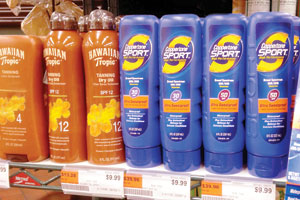 In addition, products will no longer be able to bear the words waterproof, sweatproof or sunblock and companies will need prior approval from the FDA to state that their products provide either immediate protection or protection for more than two hours.
More changes may be on the horizon as research is being done on whether SPFs higher than 50 provide any additional protection or if products should instead be labeled as SPF 50+.
The requirements will have a sizable impact on a category that Mintel estimates was worth $735 million in sales in 2011 and expects to grow to $1.1 billion by 2016. Especially since consumers who want to avoid skin cancer are among those driving sales.
Dennis Curtain, director of public relations for Weis Markets, Sunbury, Pa., said the skin cancer warnings wouldn’t apply to best-sellers such as sport sunscreens with SPFs in the 30s, baby sunscreens with SPF 50 and aloe vera, but that warnings on lower SPF products could steer shoppers toward higher coverage sunscreens.
Sports, Kids, Babies
The most popular brands at Weis reflect a broader trend. Products emphasizing their sport or active aspects including Coppertone Sport, Banana Boat Sport Performance and Neutrogena Wet Skin suntan lotions were among the top-selling in supermarkets, drug stores and mass merchandisers (excluding Wal-Mart) combined, during the 52 weeks ending May 13, according to SymphonyIRI Group.
For families, Coppertone Kids, Coppertone Water Babies, and Neutrogena Pure and Free Baby were among the top 20 brands, according to the same metric.
Southfield, Mich.-based Hiller’s Markets caters to the needs of families with small children. “The consistently strong varieties are the [sunscreens] for kids and babies,” said Boti Nemeth, assistant director of operations and buyer for health and beauty care products.
Emerging specialty and high-end sunscreens, such as Aveeno Active Naturals Continuous Protection, also rank high, according to SymphonyIRI.
“More and more people seem to know and appreciate the difference between the commodity brands and some of the brands with healthier ingredients,” Nemeth said. “When Dr. Oz talks about Blue Lizard sunscreen from Australia, people listen and so do we. You will find it on our shelves.” Dr. Oz addressed sunscreen on an episode in 2010 and recommended products, including Blue Lizard, that contain ingredients which prevent skin discoloration.
Fortunately for brand-loyal consumers, many sunscreen manufacturers have already addressed the guidelines and announced when they can expect to see new packaging. Coppertone products already meet FDA guidelines for broad spectrum, and Neutrogena has explained how its Helioplex technology fits into the new definitions.
Mary Ellen Burris, senior vice president of consumer affairs for Wegmans Food Markets, related how regulations will affect its private-label sunscreen in a post on Wegmans’ Fresh Stories blog. “I don’t know about you, but I get very confused by the variety of sunscreen products and recent government regulations that are intended to make labeling easier to understand,” wrote Burris, who enlisted the help of Wegmans’ sunscreen buyer and quality assurance specialist to address the changes.
They explained that Wegmans’ private-label sunscreens already comply with an FDA requirement mandating the use of a drug facts box. Its products don’t claim to be waterproof or sweatproof so the rule prohibiting use of these terms does not apply.
Wegmans also doesn’t carry any private-label sunscreen with an SPF lower than 15, and all of its sunscreens offer UVA and UVB protection, so none will carry the skin cancer/skin aging alert.
Private Labels Shine
Wegmans’ support of its private-label sunscreen reflects the larger sunscreen market. According to SymphonyIRI, private-label suntan lotion and oil lead all other brands by bringing in nearly twice what Coppertone Sport Suntan Lotion & Oil, the next ranking brand, brought in.
But not all retailers reap the benefits of a private label. Although Hiller’s offers Minneapolis-based Supervalu’s Equaline private-label alternatives in the sun care category, they do not sell well.
“You’d think people would opt for a sunscreen with similar ingredients and same size for a significant savings, but they do not,” Nemeth said.
Supermarkets’ biggest competitors are drug stores, according to Mintel, for their wider selection. The impression given by the on-staff pharmacists that drug stores are a better resource for understanding the benefits of sunscreen protection against skin cancer is another factor. Supermarkets with in-store pharmacies can use that information when placing displays.
St. Louis-based Schnuck Markets keeps sunscreen on moveable racks that allow it to adjust locations, said Paul Simon, senior communications specialist at Schnucks.
In addition to promoting whole foods that help absorb UV rays, Chandler, Ariz.-based Bashas’ stocks both national brands and its Food Club and Topco private labels in health and beauty displays as well as by the checkouts.
A supermarket’s geographic location can also impact sunscreen sales and product selection.
Across the state of Michigan, Hiller’s sees its stores that are closer to lakes and colleges selling more sunscreen.
“We do have stores that are closer to lakes, and sales of products from the sun protection category reflect this,” Nemeth said. “Our Ann Arbor store is also a pretty good one for this. This tells us younger people do care about protecting their skin.”
In fact, teens are more likely than adults to use sunscreen, according to Mintel. Women comprise another key demographic.
Products lacking the skin cancer warning will appeal to women in particular since they are more likely than men to use sunscreen for skin health and to protect against premature wrinkling of the skin.
As consumers become more aware of the benefits of sunscreen through FDA-mandated labeling and conscious of the risks of skin cancer and skin aging through sun exposure, sunscreen sales will benefit, and with the right marketing and displays so can supermarkets.
Sidebar: Sunscreen Not Just in a Bottle
In addition to conventional FDA-approved sunscreens, Barbara Ruhs, clinical dietitian at Chandler, Ariz.-based Bashas’, has been promoting tomatoes that, when eaten, provide some UV protection.
Certain plant compounds can absorb UV rays and decrease sunburn or provide protection against free radicals. In the August edition of Environmental Nutrition, Ruhs wrote about how foods with beta-carotene, such as carrots, mangoes and kale, provide protection against free radicals and possibly skin cancer, and lycopene-rich foods such as tomatoes help protect against sunburn.
Shoppers at Bashas’ will find signs throughout the produce department that highlight these and other health benefits of whole foods. Ruhs said that she has yet to hear from shoppers about the tomato sign in particular, but occasionally gets feedback about what a consumer has learned from the other produce signs.
Though Ruhs writes that foods such as soy and tea can also prevent sun damage, Bashas’ doesn’t provide the same signage in Center Store.
In spite of the focus on the benefits of whole foods, Bashas’ knows that shoppers still need coverage for the outside as well and carries a wide variety of bottled sunscreen.