
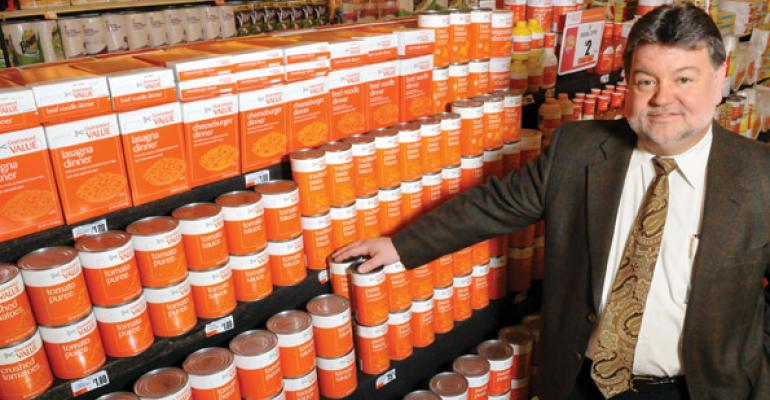
If Jeff Martin could answer the question of how each one of 49 million people in Ahold USA’s marketing areas defines “value” as it relates to food shopping, he would find a way to deliver it to them.
The executive vice president of merchandising and marketing for Ahold USA Retail leverages all the tools at his disposal to get as close to that answer as he possibly can, and seeks to provide solutions that make Ahold’s 750 Stop & Shop, Giant-Landover and Giant-Carlisle stores the “favorite place to shop” for its customers.
 If that means offering an extensive array of opening-price-point private labels, so be it. If it means offering discounts on gasoline for purchasing certain products, customers are able to do that, and if it means offering the ability to scan items with a mobile app while shopping to speed checkout, more and more customers have the ability do that as well.
Because of his efforts to provide value and enhance the shopping experience at Ahold USA’s stores, his close work with suppliers and his success in helping drive sales growth and profitability at Ahold USA, Martin has been selected as the winner of SN’s 2012 Marketer of the Year Award.
----------------------
ABOUT THE AWARD
SN’s Marketer of the Year Award is presented annually to a supermarket marketing executive who has demonstrated innovation and success. Jeff Martin of Ahold USA is the 2012 recipient, based on his work to enhance the value proposition across the company’s divisions.
SPONSORED BY ACOSTA
----------------------
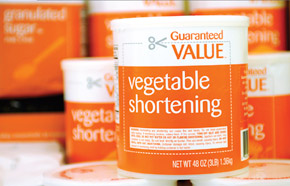
“We need to create a lot of different kinds of value for our customers,” Martin told SN in an interview this month. “We all see value in a different way. For some, value may be our Guaranteed Value private-label platform, which is dollar-store-like in its price point, or for another consumer it could be a combination of national-brand purchases and private-brand purchases.”
 At the heart of Martin’s quest to find out how consumers define value and how to best deliver it to them is the company’s robust loyalty program, which helps it gather the data it needs to deliver more personalized shopping solutions to its customers. The company tallies 85% of its sales and 74% of its transaction on its loyalty cards.
“We know what you buy and we know how you like to buy, and hopefully we can give you offers that affect your behavior in our stores,” he said. “We can give you discounts on items that you buy frequently, and maybe attract you back to items that you don’t buy often enough, or maybe we can incent you to buy new items that we think fit your shopping behavior.
 “This whole idea of linking our communication strategy — whether it be digital or email or regular old personalized mail — gives us a really unique way to build loyalty with our consumers in all of our Ahold banners.”
The company has leveraged partnerships with several outside vendors to help it maximize the value of its data, most recently with London-based EYC, which stands for Engage Your Customers. Ahold is leveraging its relationship with EYC to conduct more promotional testing and measure response to various offers.
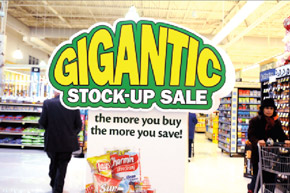 Late last year, Ahold conducted a mailing that included 2.5 million unique offers, customized for each individual household based on past shopping behavior.
The way the company has enhanced its value proposition illustrates its propensity for sharing best practices not only among its individual divisions in the U.S., but across the Atlantic between its European and U.S. operations.
From Europe, Ahold USA has learned a lot about how to market and merchandise private label, and it has also learned how to make its supply chain and purchasing more efficient and leverage its scale to take costs out the system, allowing it to provide more value at the shelf, Martin explained.
 In the U.S., the company’s Giant of Carlisle, Pa., banner has become a model not just for the other U.S. banners, but also for the European businesses in terms of its loyalty offering. The recent relaunch of the Stop & Shop and Giant-Landover loyalty programs was based on the history of success at the sister U.S. banner.
“Giant-Carlisle was the leader in the U.S. in terms of the amount of transactions being done on the loyalty card, and we believed if we could get to that high level in transactions across the U.S., we thought we could get much more robust information on shopping behavior,” Martin said.
He said that through the programs developed in conjunction with the card, such as the gas-rewards program, Ahold has been able to get “close to and in come cases slightly exceed” Giant-Carlisle’s performance in all of its divisions.
“We’ve been extremely pleased with the way we’ve been able to push value through the card,” Martin told SN.
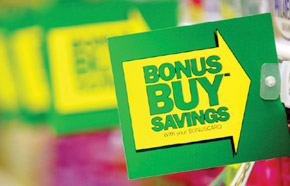
The loyalty card also provides a vehicle for working with vendors — consumers can earn bonus points for purchasing certain products, and vendors have been eager to participate, Martin explained. The company typically offers three such products each week on the backs of its circulars.
The card is also closely linked to the company’s electronic communications vehicles, so that customers can check their rewards points via the web, and receive special offers that they can download to their cards to redeem at checkout.
Propensity for Testing
Jim Hertel, managing partner at Willard Bishop, Barrington, Ill., said Martin and his team have a strong willingness to experiment that helps drive the company’s learning and contributes to its success. They also collaborate with suppliers very effectively to arrive at pricing and assortments that drive sales and profitability, he explained.
“They are very sharp, and they are very willing to engage in very rigorous debate with the supplier community,” Hertel said. “It’s not an old-style confrontational relationship — It’s the kind of relationship where both sides really need to be committed to finding out what’s the truth, and having a vigorous debate about what’s the right thing to do.”
He noted that Ahold has a long history of sharing its data with vendors, which contributes to more informed decisions.
The company’s willingness to experiment with new things — such as its Scan It! handheld self-scanner deployment, now in 339 stores — also contributes to its success, Hertel explained.
 “They are not going to hit home runs on every one, and they might not even get base hits on everything they try, but I think what characterizes them is they are open and willing to try a lot of different things,” he said.
The self-scanner system provides Ahold with another vehicle for delivering targeted offers.
“They have been out there with a lot of things early, and not all of them worked, and not all had a game-changing impact,” Hertel said. “But they are always approaching it with an experimental mindset of, ‘Let’s try it and see. What’s the worst that can happen?’”
That’s an important attitude to have in the fast-changing world of digital communications and technology-enabled marketing, he explained.
 “You have to be willing to try a lot of different things, and be willing to fail fast,” he said. “There are a lot of organizations that don’t want to do that — they would rather try one thing and be 100% right than try 20 things and have five of them work, but those five just keep you on the cutting edge.”
More recently, Ahold has deployed a smartphone application for use in 21 of its stores that allows customers to use their iPhone or Android mobile device. The company plans to expand that test soon with an eye toward full rollout by year-end.
Private Labels
A major factor in Ahold’s sales growth in recent years — as well as its success in negotiating with vendors — has been the success of its multi-tiered private-label program.
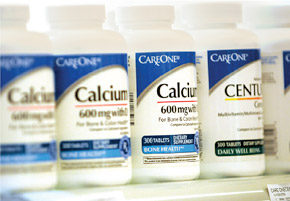
Ahold recently switched to a unified look across all of its chains for its national-brand-equivalent line, and this month began touting the new packaging for its Guaranteed Value private label that makes the product stand out on the shelf, Martin said. Other labels include Nature’s Promise natural and organic products, CareOne items in the HBC category, and Simply Enjoy specialty products. It also has private-label pet and diaper brands.
The move to a common national-brand equivalent across all divisions gave Ahold better economies of scale and improved supply-chain efficiency, Martin explained. The company also moved nutritional information to the front of the packaging and did a quality audit on the products.
 Martin said the company sees opportunities for more private-label offerings in fresh product.
“Private label is going to a big part of our plan going forward, both in the U.S. and in Europe,” he said.
Ahold is also taking a closer look at overall product assortment, particularly in general merchandise and dry grocery, with an eye toward replicating some tests that have been done in those areas at Giant-Carlisle into its Stop & Shop and Giant-Landover banners.
Burt Flickinger, managing director, Strategic Resource Group, New York, said Ahold USA has a big opportunity to leverage its marketing expertise to drive sales at the recently acquired Genuardi’s stores in the Philadelphia area and to continue to apply the success at improving Stop & Shop’s image at Giant-Landover.
“[Martin’s] innovative thought leadership in marketing, and his use of ad agencies and other resources, really has been able to stave off the competition from nontraditional formats,” he said. “They’ve done a good job of improving the image of [Stop & Shop] in consumers’ minds as a place to get good values.”
Martin himself is quick to credit his team.
“Ahold’s success is really a reflection of a lot of hard work by a lot of people and the support team,” he said. “I’m very fortunate to work with them. I am always humbled by my opportunity to work with them.”

