
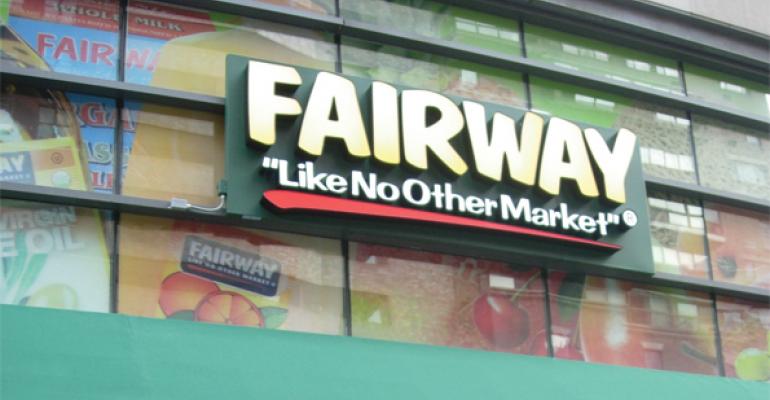
NEW YORK — Fairway Market is going public behind a strategy to triple the number of stores it operates in the New York metro area and eventually, expand its brand of productive, fresh-focused stores throughout the East Coast.
Fairway, which currently operates 11 stores in and around New York, said it could build at a rate of three to four new stores a year and cited demographic research indicating the Northeast between New England and Washington, D.C., could support 90 Fairway stores. The company said it could open as many as 300 stores nationwide.
In a registration statement filed with the Securities and Exchange Commission last week in preparation for its initial public offering, Fairway detailed eye-popping sales figures, as well as ongoing losses and comparable-store sales declines associated with its rapid expansion and sales cannibalization as new stores open.
For the fiscal year that ended April 1, Fairway generated sales of $554.9 million and a loss of $8.3 million. Those results cover nine stores; it has since opened two additional locations. Through the first quarter of the current fiscal year, which ended July 1, Fairway lost $3.9 million on sales of $154.7 million. Its stores in the fiscal year and first quarter experienced comparable-sales declines of 7% as a result of new stores providing shoppers with more convenient options than existing stores, Fairway said.
As a “destination store” Fairway said it focused less on comparable-store results than other retailers, saying its focus was on increasing net sales and gross profits. Its efforts on margins will continue around price optimization, shrink reduction, labor productivity and increasing leverage from scale. It said it expected to post net losses through 2014.
Its stores during the fiscal year ended in April were averaging $1.47 million in sales per week, and averaging sales of $1,859 per selling square foot, making them among the most productive boxes in the industry. Gross profit margin during the year was 33.5%.
Fairway described its business as a unique format combining the appeal of specialty food stores like Trader Joe’s and The Fresh Market; organic/natural retailers such as Whole Foods; and conventional supermarkets like ShopRite and Stop & Shop. Perishables and prepared foods account for nearly 65% of sales at Fairway, compared to the more typical one-quarter to one-third of a supermarket’s sales, Fairway said. Specialty items accounted for 7.2% of Fairway’s fiscal 2012 sales while conventional grocery products accounted for 28.2%.
Its positioning allows it to benefit from trends toward healthy eating; increased shopper emphasis on their in-store experience; and growing interest in private-label offerings. The company said its Fairway-branded items, including olive oils, spices and prepared foods, account for around 7.5% of sales and generally are the top-selling items in their category.
Fairway said it aimed to keep its pricing below that of specialty and organic retailers for fresh, natural/organic and specialty items, while remaining competitive with conventional supermarkets on grocery items. A new price optimization initiative launched late last year has led to higher margin rates by analyzing how demand varies based upon price points and other data, Fairway said.
Read more: Fairway Sets Another N.J. Opening
“We believe that our distinctive merchandising strategy has enabled us to build a trusted connection with our customers, who value the quality and fair prices of our food, our merchandising teams’ expertise and our one-stop-shopping convenience,” Fairway said.
Fairway plans a Manhattan store will open in November and a store in Nanuet, N.Y., in 2013. The company has asked New York City’s Industrial Development Agency for $3.7 million in tax benefits toward a new central bakery and commissary in the Bronx, which would allow the chain to transfer such functions away from stores. A public hearing on the matter is scheduled for this week. If approved the new facility could be open by next spring.
Directors, Senior Executives
The filing also disclosed Fairway’s board of directors and a senior executive team, installed this spring under Herbert Ruetsch, the chief executive who succeeded Howard Glickberg in February.
Ruetsch joined Fairway in 1998 after 16 years at Grand Union, and formerly served as Fairway’s president, chief operating officer and chief financial officer. His team consists of William Sanford, president and chief financial officer; Kevin McDonnell, chief operating officer; Nathalie Augustin, general counsel; Aaron Fleishaker, senior vice president, real estate and development; Brian Riesenburger, chief merchandising officer; Larry Santoro, chief administrative officer; and Peter Romano, vice president of produce. These eight serve on a board of directors chaired by Sterling co-founder Charles Santoro and also including Howard Glickberg, identified as a director and vice chairman of development; and Daniel Glickberg, Howard’s son and a Fairway vice president. Three other Sterling appointees are also on the board.
McDonnell was named COO in March and previously served as Fairway’s chief merchandising officer. He is a 27-year veteran of A&P, serving most recently as a senior vice president of sales and marketing. Sanford, named president in March and chief financial officer in April, has served Fairway since 2008 and is an operating partner at Sterling.
The company said it would use proceeds from the IPO — reportedly $150 million although the filing last week did not include precise figures — to fund an unspecified dividend for its owners and to support Fairway’s growth plans. It would list “Class A” stock on the NASDAQ exchange under the symbol FWM. The company, which filed as Fairway Group Holdings Corp., would remain a “controlled company” with less stringent requirements concerning the independence of the board of directors and its committees under the corporate governance rules of NASDAQ. Also, as an “emerging growth company” under the JOBS Act, Fairway is permitted rely on exemptions from certain accounting and executive compensation disclosure and stockholder advisory vote requirements that are applicable to other public companies.
In other details:
• The company detailed an agreement with Boone, Iowa-based supermarket operator Fareway Stores, prohibiting the New York entity from using the “Fairway” name on stores except on the East Coast, California and in certain parts of Michigan and Ohio. A separate settlement prohibits Fairway from opening any new stores under that name in the New Jersey counties of Bergen, Essex, Hudson and Passaic, following a dispute with a different retailer in Fort Lee, N.J., also using the Fairway name. “We believe this agreement will preclude us from opening one store that we otherwise might have opened in this territory,” the company said.
Read more: New York's Fairway Mulls IPO
• A Department of Homeland Security audit last year revealed that Fairway’s Pelham Manor store in the Bronx employed as many as 55 workers who did not have valid employment authorization documents. As a result of that investigation, Fairway fired 35 workers this spring and may still face fines or other penalties as a result of the audit.
• The company’s flagship store on Broadway in New York’s Upper West Side may face disruption as a result of potential renovations or rebuilding of the property. The landlord for a building above half of the store may terminate Fairway’s lease to make these renovations in 2017.
• The company is in a dispute with the landlord of its Red Hook store in Brooklyn over utility expenses.
| Suggested Categories | More from Supermarketnews |

|
|
|
|
|

|
|