
NEW YORK — Inflation and lingering economic sluggishness are likely to continue to confound the industry well into next year, according to a panel of seven industry analysts at SN's 16th annual Analysts Roundtable here.
“If the economy doesn't improve, the consumer will be in worse shape next year, and rationality may not prevail the way it has so far this year,” John Heinbockel, managing director for Guggenheim Partners, New York, said. “I'm much more concerned about what happens when the clock turns to 2012.”
Scott Mushkin, managing director for Jefferies & Co., New York, also said conditions could get worse. “I can't believe I'm saying this, but I believe we're looking at packaged food inflation of probably 5% to 8% in the back half of the year, [so] the second half of 2011 may end up being very challenging, [and] there's fear about 2012.
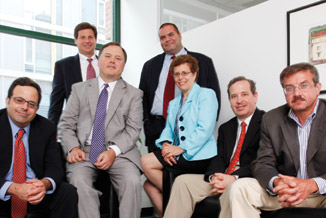 From left: Andrew Wolf, Scott Mushkin, Mark Wiltamuth, John Heinbockel, Meredith Adler, Gary Giblen and Chuck Cerankosky.
“Every gauge we look at indicates the unemployment rate is probably heading higher, and that does not bode well for the back half of the year. It means there will be more trading down, and this rational environment could easily break down.”
Consumers are continuing to suffer and to experience more uncertainty, Andrew Wolf, managing director for BB&T Capital Markets, Richmond, Va., pointed out. “To be in the middle of a recovery and have the middle class buying less is a new thing for our economy, and that has really hurt the industry,” he said.
Problems created by the weak economy will take a long time to resolve, Chuck Cerankosky, managing director for Northcoast Research, Cleveland, said.
“You're hearing more and more food companies saying they are trying to get gross margin dollars even. They're not even talking about getting back the margin. And the retailers are threatening CPGs with private label.
“There's a lot of worry about passing costs along to a customer who isn't necessarily going to take it. It will require time, especially with employment numbers going in the wrong direction.”
 Meredith Adler
 Even private label is becoming less of a safety valve for most chains, Gary Giblen, managing director for Aegis Capital, New York, said. “The increase in the pace of private-label mix is slowing, and if the chains don't have that safety valve, then [problems resulting from the weakened economy] become more serious concerns for them.”
Things could get worse if the market becomes less rational, the analysts said, though they disagreed on who might upend the status quo.
“It might be Wal-Mart — whose price spreads have been narrowing — that ends the rational environment,” Mushkin said. “Wal-Mart's consumable volumes are now negative, and if it tries to turn volumes higher through price investments, it's potentially a big problem.”
 Chuck Cerankosky
 Meredith Adler, managing director for Barclays Capital, New York, suggested Wal-Mart Stores might not have to do anything to change the dynamic “because if a certain number of people hit a budget constraint and decide to go somewhere else, then Wal-Mart can pass the current inflation through and still be the low-price leader by maintaining the same spread it had before. It can be the one place, by default, that many people can afford.”
Mark Wiltamuth, executive director for Morgan Stanley, New York, offered a similar opinion, noting Wal-Mart is more likely to “drag its feet passing through inflation and let inflation do the dirty work on widening the pricing gap. Wal-Mart is going to let the grocers push up inflation while it holds prices as much as it can. It's not going to be a sexy way to open up the gap, but I think that's what it's going to do.”
 Gary Giblen
 Heinbockel suggested it may not be a national player who takes the lead on more aggressive pricing. “It could be painful locally if someone like Wegmans wants to get more aggressive, or Publix wants to do it — and if you happen to be in those markets, you're in trouble,” he said.
The analysts agreed that Kroger Co. is best positioned among the major conventional chains to withstand the industry's competitive pressures, “[with] one of the best models in consumables retailing right now,” Heinbockel said. “Its 4% or 5% comp and its price position mean it can afford to invest selectively in price and simultaneously expand EBIT margin — the best of all worlds.”
But for companies whose sales are already declining, the next couple of years could be particularly problematic, they pointed out.
 John Heinbockel
 “Both Safeway and Supervalu are losing market share right now, and it's those two, which are trying to play catch-up, that are at greater risk,” Wiltamuth said. “Both were late to the party when it came to cutting prices, and it's hard to really stimulate and bring that customer back. Now, with an inflating environment, it's even harder to reposition your relative price in the marketplace.”
For Minneapolis-based Supervalu, one of its biggest assets, Adler said, is its “phenomenally convenient locations.”
Supervalu also has a lot of low-hanging fruit, she added. “There are so many things that were done poorly that it has the option to fix, and it may not have to make radical changes to its pricing to show some improvement, even if it's only less sales deterioration.”
 Scott Mushkin
 For Pleasanton, Calif.-based Safeway, inflation is particularly galling, Wolf pointed out, because it lowered thousands of prices in 2010 and is unlikely to go even lower. “Nobody is doing well if they aren't focused on value. I think Safeway [is] positioned halfway there, [but] does it have the patience and the forbearance and determination to change?”
Wiltamuth said he doubts Safeway will change its pricing. “Safeway has laid its stake down, betting on differentiation and higher-quality remodels, and it has made the decision that it will not go below the competition on price. It almost feels like the Safeway strategy needs some upward plane to the economy for the lifestyle remodel strategy to work because I don't think [it] is willing to cut the price and chase other strategies at this point.”
 Mark Wiltamuth
 Wal-Mart may be struggling a bit as it copes with two years' worth of negative comp sales, the analysts said. “Wal-Mart exerts enormous pressures on the industry — and there is enormous pressure on Wal-Mart as well,” Mushkin said.
Wal-Mart may be caught “between a rock and a hard place,” he added. “If it invests in price, it will really hurt earnings and the company may not get enough incremental sales to justify the lower prices — and if it doesn't invest, it looks like it will continue to bleed share.”
The company may also be losing some of its strong price reputation, Wiltamuth said, pointing to a survey he did of 1,100 Wal-Mart shoppers that indicated only one in four viewed its prices as significantly lower than those of grocery stores.
 Andrew Wolf
 According to Wolf, “Wal-Mart has not been happy seeing its low-end customers going to dollar stores, [so it] is reloading on consumables inventories and [putting] dollar items all over the place.”
Adler said supermarkets can continue to blunt Wal-Mart's effectiveness with strong promotional prices. “Everyday low price cannot match an advertised price — not unless you want to absolutely destroy earnings,” she said.
“Wal-Mart is stuck in a box — a very small box — and it's made of iron, which makes it hard to get out.”
Wiltamuth said he doesn't see much relief for Wal-Mart. With sales of consumables more dependent on low-income shoppers, “Wal-Mart is going to have a hard time turning that part of the store around, and the consumables are going to have their own problems, given the inflation issue,” he said.
THE ROUNDTABLE
The full text of the first part of the roundtable follows:
SN: How has the slow pace of the economy affected the supermarket industry?
Gary Giblen: It's made it hard to pass through inflation. That's probably the No. 1 issue going forward — can supermarkets continue to pass through all or most food inflation, given weakened consumers who are rapidly exhausting their unemployment benefits? Some retailers, such as the dollar stores, have recently said they'll go for low margins to drive sales. Furthermore, in a bad economy, people trade down and they become extremely sensitive to the rapidly rising food prices. So it's likely we'll see a big margin squeeze among supermarket operators.
John Heinbockel: I think what's happened this year has been good for the industry in two respects. First, we've gotten tremendous pass-through of price increases. Wal-Mart has led the charge and others have followed. That doesn't really surprise me because I think the alternative — to eat a lot of inflation — is just a non-starter. Second, demand has held up quite well, which might surprise some people.
Looking at those two factors, I think the key is the payroll tax holiday, which for the lowest-income households represents $600-plus a year. That tax benefit is basically funding higher food and gas inflation. There's not a lot left to buy other things, such as furniture or apparel, which is why discretionary sales are so bad. But I think the benefit is funding food and gas inflation, and year-to-date the demand environment has actually been pretty good.
My concern is, if the economy doesn't improve and if the payroll tax holiday isn't extended or expanded, the consumer will be in worse shape next year, and rationality may not prevail the way it has so far this year. I'm much more concerned about what happens when the clock turns to 2012.
Chuck Cerankosky: That's a great point. We're in the second year of an economic recovery, and we're still talking about trading down, not trading up.
Another important aspect to consider is the net worth side. Whereas a lot of people in Middle America don't have a big stock portfolio, they've seen their home equity portfolio crushed, and that's a big, big part of what people think about. Jobs are weak, food inflation is creeping up, fuel inflation is very high and the big, traditional American asset — the home — is under a great deal of pressure, and that's impacting how people shop for everything, including food. I don't think anybody realized how far down you could trade in food categories until you look at the last three years.
Meredith Adler: Since the recession started, people are looking for deals. There is a lot of cherry- picking going on, and one of the consequences is that even a company like Wal-Mart, with everyday low prices, is not keeping its customers. It's losing parts of the business because other companies are beating it on advertised prices. Is that necessarily a trend that's going to last forever? Probably not. But for now it's a very big change. It even turned Wal-Mart into a promoter two years ago, though that didn't work. But I think Wal-Mart's current approach presents a very big challenge.
Cerankosky: One reason is that unemployed and under-employed people have the time to shop for deals.
Mark Wiltamuth: This economy has also led to a big separation within the population — creating a bifurcated economy — where the lower-end customer is literally living hand-to-mouth and the well-heeled, upper-income consumer feels more confident, with some of them even trading up. You can see those trends in the results at Whole Foods and Fresh Market. But we're still seeing trouble at the low end of the market, with Wal-Mart experiencing negative same-store sales two years in a row and Target seeing some pressure in its comps early in the year. And most of the grocery chains will tell you their low-end customer is struggling. So it's definitely tough out there for the consumer.
Against that backdrop, we've had a separation of performance among the supermarket operators. Kroger has proven it can drive its own sales behind its strategy of reinvesting in lower prices, while we've seen trouble at Safeway and Supervalu. There's a dramatic difference between Kroger's results and what we've seen from the other two.
Giblen: Private label has been a very nice safety valve for Kroger and other chains because if consumers have to trade down to private label, it's quite beneficial to the dollar profit as well as margin percentages. But there's only so far you can go with private label. The increase in the pace of private-label mix is slowing, and many chains are getting closer to the exhaustion level, with many chains going as far as they can with private label. And if the chains don't have that safety valve, then all these things we've talked about become more serious concerns for them.
Andrew Wolf: John said it well — things are a lot better than they were. But you can see, to Mark's point, how precarious this recovery is. Things really started softening for nearly everybody as soon as gas prices went up — for grocers, for Best Buy, for Wal-Mart. The hike in gas prices alone was almost enough to derail this mini-recovery for supermarkets.
The other thing is, there's not just a bifurcation among shoppers. The big news, as Steve Burd [chairman, president and chief executive officer of Safeway] said, is that 75% of customers feel they're in the bottom half now. So those kinds of negative feelings have really crept up to the middle class, and those consumers feel really insecure. To be in the middle of a recovery and have the middle class change its behavior — buying less because gas prices went up — is a new thing for our economy, and that really has hurt the industry.
There's recent research from NPD Group that looked at high-end restaurant consumption, and the results indicated that only 24% of consumers felt optimistic. Those people came from totally different backgrounds and demographics, but they shared one thing in common — they were affluent and felt secure about their jobs. The other 76% were in that “feel cautious” group. I really want to underline that because that's the kind of economy we're dealing with.
Wiltamuth: As inflation keeps playing out, we're actually concerned about the outlook for the rest of this year. I think the more inflation goes up, the more negative volume reaction we're going to get out of the consumer. Safeway's results — where we saw inflation grow and volume fall from 0.5% in the first quarter to minus-1.6% in the second quarter — is one of the warning signs for the industry for the rest of the year.
Scott Mushkin: That's just what I was going to say. There's fear about 2012, and I think the fear that's creeping into the stocks is that the second half of 2011 may end up being very challenging. All our data says employment is the No. 1 indicator of what the customer is going to be doing, and every gauge we look at indicates the unemployment rate is probably heading higher, and that does not bode well for the back half of the year. It means there will be more trading down, and this rational environment could easily break down. It might be Wal-Mart, whose price spreads have been narrowing, that ends the rational environment. We hear Wal-Mart's consumable volumes are now negative, and if it tries to turn volumes higher through price investments, it's potentially a big problem.
Wiltamuth: Yes, Wal-Mart is starting to talk about widening the gap with its competitors again. You've heard it say this before, but there's a real sense of urgency that after two years of negative comps, it's going to have to start widening the gap, and that's going to put some market-share pressure on the supermarket chains.
Heinbockel: I don't think Wal-Mart will do that, at least not in the back half of this year and into 2012. But I think it will get aggressive on non-consumables, and I think it will continue its strategy of pushing pricing up on consumables. It hinted at that during a recent store tour in New Jersey when it basically said there are bigger opportunities in non-consumables than in consumables.
At the end of the day, consumables carry a 23% gross margin, while non-consumables are at 30%-plus. And there's no demand elasticity out there. So if you're going to take your lowest-margin category and drive the margins even lower and not get the volume back, then it's not going to work. You have a better chance of making it work if you take a 30%-plus margin category — like apparel or selected hard lines — and become more aggressive on price, which may get you more volume, particularly around the holiday season. But you're not going to get that with consumables.
Wolf: Wal-Mart built its reputation on price, but it has screwed that up somewhat and it's been trying to fix it. But a lot of Wal-Mart's issues were around SKU reduction — maybe more so than price creep. If it goes down that road now, it is going to have a couple of bad years like Kroger had seven or eight years ago, and its ID sales are going to turn more negative.
Last year when people said Wal-Mart was going to get more aggressive on price, it was because of expectations that savings from international sourcing and cycling one-time operational costs could fund at least some of it. And there's no doubt Wal-Mart could do it, with its balance sheet, but it hasn't done it in a long time. My pricing studies in Richmond indicate Wal-Mart had stopped raising prices during the second quarter but only after it had raised prices 4.5% in the first — and prices have recently begun going up again. The bottom line is, like any other company, Wal-Mart is going to blow out its P&L. If it has inflating product costs coming in and it doesn't raise them, there's no magic recipe for the P&L.
Wiltamuth: Wal-Mart isn't going to take margins down. What's going to happen is, it's going to drag its feet passing through inflation and it's going to let inflation do the dirty work on widening the pricing gap. Wal-Mart is going to let the grocers push up inflation while it holds prices as much as it can. It's not going to be a sexy way to open up the gap, but I think that's what it is going to do.
Adler: I think it's important to keep in mind that the inflation we've seen so far this year has really been concentrated in perishables. People are used to volatility in the price of perishables, and there's a lot of substitution. Supervalu pointed out there are lots of ways to encourage that kind of substitution. But if you were to get 6% or 8% inflation in the majority of the dry grocery categories, it would hurt the consumer. However, I also think the manufacturers are scared, and they don't want to just hand market share to private label.
Mushkin: It's happening right now, though. Companies are raising prices way more than the retailers have generally talked about. For example, Kellogg was talking about how it needs more, not less, in the back half of the year. I can't believe I'm saying this, but I believe we're looking at packaged food inflation of probably 5% to 8% in the back half of the year.
Wiltamuth: The bigger issue is that it may not be a one-year event — it may extend to two years — because all the soft commodities are very tight right now. The summer is just roasting the corn crop, so we may have another really bad year for corn and other commodities. And that's going to pressure the suppliers, and the suppliers are going to have to keep layering that on. Right now, with the CPI food-at-home index running at 4.9%, we are already out of that comfort zone where the grocer likes to operate — that 2% to 3% inflation range. And if this continues, it's going to be volumes down from the consumer.
INFLATION'S IMPACT
Mushkin: Meredith is right when she says inflation has largely been in perishables. But in the last month or two, it's been spilling across other categories.
Heinbockel: It's in virtually every item in the store, which brings up a bigger question: If inflation continues to squeeze out discretionary spending, do the companies that sell consumables actually look pretty good compared to everybody else, whose business is very weak?
Adler: It would be great if that was true, but the 25% who have money to spend actually spend a lot of money. I did a study where we looked at quintiles of households by income, and for all spending, the top quintile spent as much as the bottom three combined. But when it came to food, the bottom three spent more. So a total pullback in discretionary spending was more true when all consumers were scared and pulled back. Everyone focuses on Wal-Mart being the one that will start the trouble, but there are a lot of other retailers that can cause trouble.
Giblen: Dollar stores already have begun to cause trouble.
Heinbockel: But Kroger already said it's not going to price off the dollar stores. If Kroger wanted to stir things up, it could. But it's behaving, and I think it will probably continue to do so. But once you get beyond Kroger and Wal-Mart, it becomes very local. Costco's not going to do it. Target's not going to do it. So it could be painful locally — for example, if someone like Wegmans wants to get more aggressive, or Publix wants to do it, they could, and if you happen to be in those markets, you're in trouble.
Adler: I agree, except even some of those guys have a fair number of places they go. I agree it's not going to be national.
Mushkin: We just don't know. Granted, we know the employment picture is terrible, we know real earnings are going down, and there's also tremendous stress from commodity price increases.
If you look at pricing in Los Angeles, you have to ask how the average person is going to deal with the situation there, with gas prices at $3.90 a gallon and grocery prices up 5% to 6%. So if you're a person making $40,000 to $70,000 a year, the stress looks to be mounting, and when we hear all these companies saying everything is fine, I am skeptical.
Heinbockel: It's clearly bad for that customer — it's tough going out to the movies, going out to eat, buying apparel — which is why the payroll tax holiday is so critical, because that has paid for higher food and gas. If you extend it through next year, it's not a benefit nor is it a negative — the second derivative is zero. What Congress should probably do if it could is expand it to some degree — to put more money back in people's pockets. But that might be politically impossible.
Cerankosky: The bad news here is that resolving this situation is going to take a long time. You're hearing more and more food companies saying they are trying to get gross margin dollars even. They're not even talking about getting back the margin — that's a step that's going to come in the future. And the retailers are threatening CPGs with private label, and one retailer is threatening to reduce prices while another is not. There's a lot of worry here about passing costs along to a customer who isn't necessarily going to take it. It will require time, especially with employment numbers going in the wrong direction.
Wolf: Kroger is raising prices. It said it was going to pass through prices from branded manufacturers, and it wants to be very transparent about that.
Adler: Yes, but it has also said it doesn't know what the competitive environment is going to look like, and things are going to remain competitive. The one difference this year vs. last year is that Kroger has a lot more money — or “dry powder” — in its pockets than it did a year ago, and the last time Kroger spoke about the competitive environment, it sounded like everything was OK. But if you really talk to management, they say they don't have any idea what the environment is going to look like, though they are confident they are prepared to deal with whatever happens.
I think I didn't take into account enough how deflation created panic. Seeing negative comps freaked out a lot of retailers.
Wolf: Also seeing negative customer counts.
Adler: The one good thing is that inflation will make the sales numbers look better, so you probably get less panicky behavior than you did. I didn't credit that enough, even last year, because I thought this beating each other to a pulp would never end.
Wolf: Volume degradation is the big evil, and I have based a lot of my research on that, so I think I have some authority when I say there is going to be ongoing volume degradation. And as prices go up, people will buy somewhat less in terms of volume. That's not the issue. The issue is, do people go to Wal-Mart or not?
Wal-Mart doesn't even have to increase its spread because if a certain number of people hit a budget constraint and decide to go somewhere else — to dollar stores or wherever — then Wal-Mart can pass the current inflation through and still be the low-price leader by maintaining the same spread it had before. In periods of heavy inflation, it can be the one place — by default — that many people can afford, so that's another reason it doesn't have to enhance its current price spreads.
Cerankosky: A couple of years ago, we had food deflation, which normally means people buy more because it's cheaper. But they didn't. They kept their budgets flat. Now the economy is waffling again, and this time we have inflation.
Wiltamuth: I'm still amused at how investors get so bulled up when inflation comes up as a topic. Two years in a row now, investors have gotten all excited about how inflation's going to help the grocery stocks, and then when the data actually starts coming out, it ends up being disappointing.
Cerankosky: We've done a lot of work with that, using correlation analysis, and there's no correlation — it just doesn't happen.
Adler: It depends on where you see the inflation, because if it's mostly in perishables, then the retailers try to hang on to penny profit rather than going for margin — and that means they don't get incremental earnings.
Wiltamuth: We laid out a bearish call in January saying this was going to be bad news and everybody needed to buckle down, and everybody got all excited through April and May and then, boom, down it came.
Adler: I made the same call in December, and I felt pretty stupid.
Wolf: Well, that's because things were better. What really cut the knees out from under the industry was gas inflation. [Kroger Chairman and CEO Dave] Dillon said rising gas prices were taking $100 monthly from households. My own research indicated the average household's increase in monthly expenses due to inflation was $70 for gas and $30 for food, and while that could change, the point is what really is killing things is gas going up a buck a gallon and what that's doing to the low- and middle-end shoppers and to their budgets. It just shows you how precarious things are.
Cerankosky: Look at how people respond to gas promotions. If you go to a Giant Eagle GetGo station in Cleveland at the end of the month when points are expiring and there's a 30-gallon limit, you would not believe what people pump gasoline into — anything just short of Tupperware. They've got the 12-gallon tank in their car, their lawn tractor, gas cans, etc. They want to save as much money as possible on gasoline.
SUPERVALU
Wiltamuth: Two of the Big Three chains are having market-share losses. Both Safeway and Supervalu are losing market share right now, and I think it's those two, which are trying to play catch-up, that are at greater risk. Both were late to the party when it came to cutting prices, and it's hard to really stimulate and bring that customer back. Now, with an inflating environment, it's even harder to reposition your relative price in the marketplace. How do you get anyone to notice your price gap relative to competitors while inflation is pushing up everyone's prices?
Cerankosky: Supervalu thought it had the economy going in its favor.
Wiltamuth: For Supervalu, it's more of “kick the can down the road and hope the economy saves you.”
Wolf: Definitely. That's why I believe Supervalu is at a crossroads. Look at where we started off, saying the economy ain't what it used to be. Anybody here think it's going to rebound anytime soon? But one positive thing Craig Herkert [Supervalu president and CEO] has done there is, he's found good people to promote internally. He's turned Supervalu upside down, and if that had been done five years ago, Supervalu might be a different story right now.
Adler: Herkert was slow, and he made some big mistakes.
Wolf: Two years later, he's made some improvements in the business.
Heinbockel: The question is, how much damage has been done to the brands? When you've got Jewel comping down 6%, damage has been done to the brand.
Wolf: That's why I say if he had been there five years ago and been effective four years ago — because in the first year he still would have gone the wrong way — things might have been different.
Mushkin: I agree. If you look under the hood and talk to people in the industry, it seems Herkert is doing a better job.
Wolf: Contrast that to Safeway, which has suffered a real talent drain. For example, Rick Dreiling is running Dollar General, where he's bringing fresh merchandising and tighter operations to the whole dollar-store segment. Brian Cornell — he's running Sam's. These guys are talented people and were a tough loss for Safeway.
Adler: One thing Supervalu has going for it is that, although to some extent it has turned primary shoppers into secondary shoppers, it still has phenomenally convenient locations. And even though its price image is bad, I don't think its overall reputation is as bad as Winn-Dixie's was in Florida.
Heinbockel: Well, the beauty of Acme is it doesn't have to compete against a Stop & Shop. Philadelphia is a free-for-all for Acme.
Adler: I am totally on the fence about whether Supervalu can do enough, but I think there are things it could do to surprise people. For example, I think there is a lot of low-hanging fruit there. There are so many things that were done poorly that it has the option to fix, and it may not have to make radical changes to its pricing to show some improvement, even if it's only less sales deterioration. You're not seeing it yet because traffic is still negative on a two-year basis.
Wiltamuth: The big question for Supervalu is, can it recover from negative 4.4% traffic numbers year after year? That's simply very difficult to recover from. Consumers have already voted — they are out of those stores — so how does Supervalu win them back when it's been late to the party on price reductions and the stores are still in need of remodeling? Those are real challenges for Supervalu.
Mushkin: Our sources say the company is already doing a better job at executing, believe it or not.
Adler: But doesn't it take time for consumers to understand that?
Mushkin: It does. We talked to a vendor who said it's not about what you are doing today — it's about what you did last year. So it's going to take a year. And the negative traffic that Mark's talking about is a very big concern.
Adler: One positive thing about Supervalu is the debt deal it did that gave it a lot of breathing room. It now has only $1 billion in debt maturities over the next three years, so it will not have to pay down any debt this year. That relieved a lot of pressure on the company — giving it some liquidity so it doesn't have to go to the markets to refinance again for a while. With that done, Supervalu doesn't even have to think about debt for the next three years. That doesn't necessarily solve its traffic problems, but it gives the company some breathing room.
SAFEWAY
Wolf: With regard to Safeway, think about this. I said to Safeway, this cost inflation must be hell for you because you've got these signs in your stores that say thousands of new lower prices — and you've had them for a relatively short period — but now, if you pass through inflation, all you can tell customers is, “They were lower before they were higher.” I think Safeway is really at a crossroads now in terms of which direction to go — having already invested in price, will it see it through?
I was thinking what Whole Foods and Kroger and Trader Joe's have in common, and the answer is a better value image. Nobody is doing well if they aren't focused on value. Whether you are Whole Foods and you've fixed your value image, or whether you are someone who's always gone to market that way, it's almost existential. That's why I give so much credit to David Dillon. He really put his neck on the line, and I'm sure if the Kroger program hadn't worked out, the board would have gotten rid of him.
My point on Safeway is, I think it has a similar decision to make, though I don't think it's really in Steve Burd's DNA to go that way. But I think he already has Safeway positioned halfway there, and with what the company is doing with “Just for U” pricing, the question is, does it have the patience and the forbearance and determination, because it's not an easy road for a corporation to change to that extent? So I think it's going to be a really interesting business case over the next year or two.
Adler: When you look at Safeway, you see that, other than using its loyalty-card data, it really doesn't have a lot of low-hanging fruit.
Wiltamuth: I think Safeway has laid its stake down, betting on differentiation and higher-quality remodels, and it has made the decision that it will not go below the competition on price. Safeway wants to pass through price, it is going to pass through price, and it is just going through a tougher time. I think the rest of this year is going to be characterized by prices up and volume down.
Cerankosky: Safeway said it doesn't want comps to go below zero, so it slowed the pass-through of inflation enough to come up with a comp of one-half of 1% when everybody was expecting more because it was looking at Kroger's comps. But Kroger built value over time, and Safeway realizes it's not there yet. So you've got Kroger with this huge gap, Safeway struggling to get more attractive comps, and then Supervalu in a spot of its own — with 13 quarters of negative comps, it is not even in the game.
Adler: I believe some of the capital Safeway invested, even in Northern California, allowed it to simply “play catch-up.” It had starved a lot of the stores for capital because it could — that is, limited competition meant customers would not defect even if the stores got rundown-looking. But for all it's done putting money into the stores since 2004, the truth is that, from the customer's perspective, the stores went from terrible to just OK.
Cerankosky: I think Safeway walked away from a lot of the lower-end neighborhoods, and as a result, when Safeway runs into a Kroger store, it's a lot like its own store. And if it runs into an H-E-B, it's a lot like the Safeway.
Wiltamuth: It almost feels like the Safeway strategy needs some upward plane to the economy for the lifestyle remodel strategy to work. In fact, I think that's what it's waiting for, because I don't think Steve is willing to cut the price and chase other strategies at this point because he already has his bet placed on differentiation, and he's waiting for the good news on jobs and the economy to help him.
Mushkin: I'm also concerned over the fact Safeway has done a lot of the things you would want it to do, yet it's frightening that it hasn't been able to do better. The stores look better, the pricing has come down …
Wiltamuth: … and the merchandise looks good.
Mushkin: Vendors say Safeway was awful two years ago. But Kelly Griffith, who now runs its merchandising, does a very good job and as a result it is executing across the company, yet sales are actually stepping down again. So what is wrong with Safeway? It may simply be competition. It has Amazon and Target's P-fresh, and Costco is huge out there on the West Coast.
Adler: But it operates in a lot of other places. Keep in mind its biggest competitor, outside of Northern California, is Kroger, who as we have said, gets a lot of things right.
Mushkin: So your core market, where you make all your money, is being attacked by all these different operators, and then in your non-core markets you are competing against Kroger, who is brutal. Safeway may have just waited too long to fix its business.
Adler: I found it kind of amazing that Steve Burd was willing to tell us 75% of his customers were hurting because it wasn't that long ago he told us Safeway had a more upscale customer base.
Wolf: The economy has changed.
Adler: The point I want to make, though, is that you could argue that fundamentally Safeway's mindset has been wrong and that it waited too long, and it is totally unprepared to …
Mushkin: … to fend off its competition. We've been saying that for years. It should have focused on its West Coast markets a long time ago — to become the Publix or the H-E-B of the West Coast. But Safeway didn't do that. Even though its share in the Bay Area is good, it should be higher, and it may have been higher if the company had focused on its core markets.
Wiltamuth: Costco has been calling out California as a positive region for several months now, but we're not hearing that out of Safeway, which has one-third of its stores in the state.
Cerankosky: Safeway is at a point where you have to think about de-consolidation — where you say, maybe Genuardi's doesn't belong to us any more and maybe it's worth more to somebody else, and maybe the same is true of Dominick's. Then you focus on the West Coast and Canada. But it's a rough time to be selling broken divisions. The bids that people throw out there are below replacement costs.
Mushkin: Selling some divisions is something Safeway should have done five years ago.
Cerankosky: My point is, Safeway's got to focus on its strengths, and that might mean it's now time to back up a bit.
Mushkin: We heard Genuardi's was for sale for a while last year.
Adler: When I asked a competitor what was wrong with Genuardi's, he said Safeway tends to run everything like a Safeway store on the West Coast — that the acquired stores operating under other banners were too much the same. So the idea that Genuardi's is truly differentiating itself is unfortunately not true. Too many decisions are made in Pleasanton, Calif., which of course is not necessarily relevant to Genuardi's in the Philadelphia market.
KROGER
Mushkin: When it comes to Kroger, I think we're all pretty bullish. However, I think we've learned that even Kroger has a hard time with deflation. So we have to watch what's going to happen with retail pricing as we go into next year — if unemployment keeps going up, does it start to put downward pressure on pricing? — because it seems like even Kroger struggles in that environment.
Heinbockel: Kroger has one of the best models in consumables retailing right now. Its 4% or 5% comp and its price position mean it can afford to invest selectively in price, and excluding fuel, gross margin will go down only 10 to 20 basis points a quarter, but it's not going to go down 40 or 50 basis points; and at that level, with a 4% to 5% comp, its expenses are going to be levered by 20 to 30 basis points. So Kroger can invest in price and simultaneously expand EBIT margin 5 to 10 basis points a quarter on an $80 billion sales base, and to me that's the best of all worlds. Unlike Wal-Mart and Target, Kroger doesn't have the discretionary business dragging it down, on either its comps or its gross margin, and it doesn't have a negative-mix shift. So relative to everyone it competes with, it is probably in the best position it has ever been in, which is why I think it is a story that continues to work, particularly in this economy, and why I think there is still considerable upside over the next six months to a year.
Wiltamuth: I think Kroger's use of data has got to be playing a role in some of its success. Knowing about the Dunnhumby relationship, you could just tell from the way Kroger talks about its business that it is more informed than some of the other companies. Kroger is strategically investing in certain categories and making hay with it, as opposed to others, who seem to just be reacting to discounting in the market.
Wolf: Sometimes Kroger will decide to promote one category and Dunnhumby will tell it that's the wrong category and suggest another, so it's been a beautiful friendship between them. When Kroger promoted natural foods recently, sales were good and gross profit totals were actually up, and that's an example of the productivity loop at Kroger.
Giblen: One plus for Kroger is the fact there's a lot to be said for positive employee relations and the workforce productivity and friendly customer-service experience that results from it. You can't measure it in the financials precisely, but overall, Kroger has better employee relations. For example, management addresses employees via conference calls, which is viewed in the organization as much more than hollow rhetoric. Other chains operate in the opposite way — making employees feel merely like the proverbial cogs in a wheel.
Cerankosky: I think one of the really neat things about Kroger is, there's no typical Kroger store. It's got so many different looks. You can walk into one store where the reading section is 4 feet wide, and you can go into an upscale Kroger and there are hardbound books, plus a complete display of great seafood. Kroger really does a great job doing that, so it's about so much more than price — it's making sure you have the right products at the right price in the right neighborhood.
Wolf: When I look at Kroger's stores in Richmond, I see how products are priced every day and how it affects my mindset because we buy some of them. Kroger clearly has figured out how to split the middle — prices are not down there with Trader Joe's or Wal-Mart, but Kroger is below most of the rest of the market, just not to the level of the low-price leaders.
Wiltamuth: In some of our surveys, we've looked at an entire category, and you can see Kroger is dead-on low price with the two brands that the consumer will remember, and on other items it's a little higher, and a little higher, and a little higher, to the point where it's getting a premium on some prestige products, and as a result, the whole category margin probably ends up being managed better. So you look sharp for the low-price customer, and you get that price image locked in there. That's helped Kroger.
The big wildcard for Kroger is Wal-Mart. Kroger has the biggest overlap of the Big Three with Wal-Mart, and if Wal-Mart decides to change direction on pricing, Kroger's going to have to be the one to respond.
Wiltamuth: We just did a survey of 1,100 Wal-Mart shoppers, and 60% of them said they no longer view Wal-Mart as having the lowest prices. On the grocery side in particular, only one in four viewed Wal-Mart's prices as significantly lower than the grocery stores'. That's kind of stunning.
WAL-MART
SN: Is Wal-Mart losing its low-price image, and if so, what is it doing about it?
Mushkin: It's always frowned upon to say Wal-Mart can do whatever it wants, but Wal-Mart exerts enormous pressures on the industry — and there are enormous pressures on Wal-Mart as well now that its consumables volume has gone negative. We believe that's the first time that's ever happened to Wal-Mart.
Mushkin: Wal-Mart may be caught between a rock and a hard place. If it invests in price, it will really hurt earnings and the company may never get enough incremental sales to justify the lower prices — and if it doesn't invest, it looks like it will continue to bleed share.
Wolf: What Wal-Mart is doing now is reloading on consumables inventories, and now the front end, which used to be clean, is full of Little Debbie types of merchandise. And it is going after the dollar stores with dollar items all over the place, especially in food and consumables. Wal-Mart has not been happy seeing its low-end customers going to dollar stores.
Adler: Personally, I don't think there's anything Wal-Mart can do right now, certainly on price, to fix the situation because I think the problem is the shopping experience. No matter how many dollar items you put in a 180,000-square-foot store, you're not going to duplicate the experience of an 8,000-square-foot store.
Giblen: That's why Wal-Mart could go nuclear and invest much more deeply and broadly in price — maybe not tomorrow, but within a six-month period.
Heinbockel: But it won't get a lot more aggressive because it won't get a good payoff investing in price. Whole Foods got a payoff by investing in price because that had been its Achilles' heel. But Wal-Mart won't get the same kind of bang for its buck investing in price because that is already its strength. Wal-Mart has to invest in the service experience — that's its Achilles' heel. At the end of the day Wal-Mart can get a lot more aggressive and just drop prices across the board and it will hurt everybody else, but I don't think it will solve Wal-Mart's problems.
Wiltamuth: I think you're right, because if you look at the core Wal-Mart customer, it's someone whose annual income is in the low-$40,000 range, and unemployment in that population is twice the national average, so that customer is not really in a position to spend more. As a result, even if you give him the price cut, he's not going to respond. But at the same time, that's still the same customer who's saying he doesn't think Wal-Mart's prices are low enough.
Wolf: That's why Wal-Mart is putting dollar price points all over the floor. As for the crossover shopper who's shopping at multiple stores, he's in Wal-Mart thinking, “Well, I'll get this yahoo for a buck.”
Adler: But what makes them crossover shoppers? This is one of Wal-Mart's Achilles' heels. Assuming shoppers have some conventional operators available to them, people are taking the ads and comparing. And of course, Wal-Mart doesn't have an ad.
Wolf: It has an “ad match” program now.
Adler: Which is really stupid for three reasons. First, what better way to say you do not have the lowest prices than by saying you'll match the lowest? Second, I don't think customers will feel comfortable getting into an argument with the checkout clerk who's going to read the ad from the competitor to see when it expires. And that leads right into the third reason, which is that it's going to kill productivity if people seriously take them up on that offer.
Wiltamuth: It's a stop-gap measure for Wal-Mart. It's just putting that out there until it's actually able to get prices down.
Adler: I think there are a lot of temptations at a Wal-Mart store, and if you can afford to buy only 10 items because you're buying for the next two days, why would you go to a store that big?
Giblen: You'd go if you're convinced the prices are already back to being the lowest.
Adler: I don't think Wal-Mart can set its prices as low as conventional chains' advertised prices. Everyday low price cannot match an advertised price — not unless you want to absolutely destroy earnings.
Giblen: My sense is that Wal-Mart perceives it is close to solving the out-of-stock and apparel mis-assortment issues and that it will dial down pricing big time once it feels the store offering is right. That way, the traffic generated is exposed to the new, improved Wal-Mart experience.
Cerankosky: When you talk to Wal-Mart's suppliers, they tell you Wal-Mart wants a lower price, not higher quality, and that's how it's trying to get to that shelf price in certain categories — with smaller sizes or taking quality out so it hits a price painlessly.
The interesting thing about Whole Foods is it gets the value equation right with great quality, whereas Wal-Mart doesn't want to focus on quality — it wants reduced costs.
SN: So can Wal-Mart get comps back to positive territory by the end of the year as it has promised?
Heinbockel: I think it can do it in consumables, simply because of inflation.
Wolf: And by selling more product. Its consumables inventory, at least from what I'm seeing, is way up. Remember, it took everything away from the front end, which wasn't always food, and it took out the whole Action Alley, and now both are full of food.
Adler: Then how come the comps have gotten sequentially worse?
Wiltamuth: One of the other problems for Wal-Mart is, if you look at sales of consumables that are clearly comping negative in the mid-single-digit range and some in the double digits, those categories are more dependent on the lowest-income shopper. So Wal-Mart is going to have a hard time turning that part of the store around, and the consumables are going to have their own problems, given the inflation issue. So I think the company is still going to comp negative through the end of the year.
Mushkin: So it seems like we're all feeling Wal-Mart is in a bit of a box, and — unless it pursues the nuclear option and cuts prices dramatically, which I agree would not make sense from a financial perspective — Kroger is the beneficiary because it competes with Wal-Mart more than any other retailer. Also, the dollar stores just keep picking up sales.
So for Kroger, it becomes a fairly virtuous cycle because strong volume growth of 3%, plus 2% inflation, yields a 5% comp that lets it leverage expenses quite well. Our research shows that this dynamic is letting Kroger drag its heels a bit on price at retail, and, of course, that yields further share.
Giblen: Ironically, that was Steve Burd's original strategy during his first years with Safeway.
Adler: I think his strategy was to cut costs.
Giblen: Well, to cut costs but in a constructive way and lower prices from that point. But then he got sidetracked in delusions of grandeur about the superiority of the Safeway store experience, and he over-did it on acquisitions in the belief he could Safeway-ize everything and achieve vast improvements.
Adler: If Wal-Mart were to begin lowering prices, would it do it selectively, as opposed to trying to do it everywhere?
Heinbockel: Geographically, no. By category, perhaps. But I challenge all these guys on whether they understand price elasticity. Kroger will tell you as it tests strategies and works with Dunnhumby that it can get elasticities pretty much right. But I think a lot of companies struggle with that — that if they make a price investment, what's the consumer reaction and return on investment going to be? I think they all overestimate elasticity.
Adler: Of course, you want to be able to measure elasticity based on a whole lot of historical data, but I am not sure things stay the same.
Giblen: Kroger has the best tools in the industry, but it's very execution-sensitive and walking an execution tightrope that it could fall off of at any time.
Mushkin: It all depends on what the competition does. If you look at Houston, H-E-B, Kroger and Wal-Mart are all priced within 3% or 4% of each other. Houston is doing fine, and the effect of price increases on the economy is different. But it's hard to be the low-price leader when you're not the low-price leader. It's almost impossible. Therein lies Wal-Mart's challenge, but it might be a challenge for the industry.
Adler: I think Wal-Mart is stuck in a box — a very small box — and it's made of iron, which makes it hard to get out.
Cerankosky: What makes the elasticity calculation more difficult is, what's the economy going to do, given that people are trading down?
Wolf: I agree with John on Dunnhumby. It has a lot of economists and math wizards, and clearly it's probably noticing what's going on with the economy and any potential effect on elasticity, even if it is history-sensitive. Kroger is investing efficiently, and it deserves a lot of credit for it. It's one of the things that makes Kroger an interesting stock.
Wiltamuth: I think something that's going to be interesting to watch with Wal-Mart over the next few years is, what is it doing with small stores? It has decided that returns at Walmart Market — the former Neighborhood Market — are equal to the returns of a supercenter, and now it's testing the 15,000-square-foot Walmart Express.
To open enough Walmart Markets to really move the dial, it would have to do 150 to 200 stores a year to get to a penny a share of earnings impact. So it doesn't seem like the plan is to move the dial. But Wal-Mart is interested in getting these out there, which will put competition from Wal-Mart a little more in the backyard of conventional grocers.
Cerankosky: I think the reason Wal-Mart got the returns up at the Neighborhood Markets is because it raised the price of consumables enough, so instead of having higher consumable prices at the Neighborhood Market and lower ones at the supercenters, it has them both at the same higher level, so now the math works without the merchandise subsidy.
Wiltamuth: I think Wal-Mart has also been experimenting with its labor cost model, and it's learned from its international markets where it has some of these smaller stores that it can have a more flexible labor model.
Wolf: I think the smaller Wal-Mart store is definitely the big risk for the industry, even more than pricing. I've heard that in the Seattle area Wal-Mart was trying to get approval for a 200,000-square-foot parcel and the locals said no, so now it's going in with a 40,000-square-foot store and the locals are very comfortable with that. That's going to be a productive store. And if Wal-Mart opens 200 of those a year …
Cerankosky: The problem with counting on that store format to make a big impact on the conventional guys is that Wal-Mart will still be very weak in perishables.
Adler: Wal-Mart did well with supercenters because they were really differentiated, especially on price. Now those stores don't have the best price image, nor the in-store specials, nor the kinds of bells and whistles you find at a Kroger. It's usually very hard to enter a new market with a conventional format where one conventional chain is already dominant, and I think that's going to be challenging for Walmart Markets. I think real estate is going to be a huge challenge as well.
What about acquisitions? Do you think Wal-Mart would ever buy the Great Atlantic and Pacific Tea Co.?
Wiltamuth: I think Wal-Mart wants to avoid anti-trust review, so I think it will continue to grow organically.
Cerankosky: And it doesn't want a union.
Heinbockel: I'd be surprised if it took anything unionized. Even if it was a very loose sweetheart contract. I think that's a non-starter.
Wiltamuth: That's the beauty of the small stores — you can get into all sorts of areas, including the New York metro area — and at 15,000 to 40,000 square feet, there are plenty of opportunities out there.
Adler: But is Wal-Mart going to open 200 of those a year?
Wolf: It was doing 300 supercenters a year, so why not 200 smaller ones?
Adler: That was a long time ago, and it was different geography.
Wiltamuth: Drug stores aren't growing like they used to, so there are sites out there that are available.
Adler: It's not so much the size of the box — it's the parking. You're not going to take a drug store pad and put a 40,000-square-foot Wal-Mart there.
Heinbockel: Wal-Mart couldn't afford the rent that a drug store could because the margins are that much higher at a drug store, particularly the front end.


