
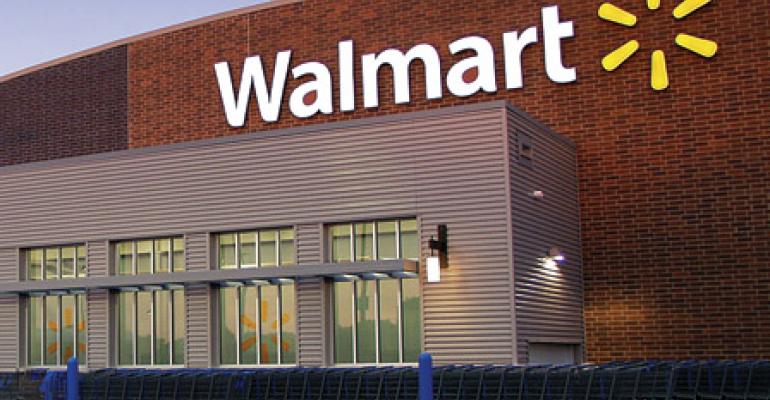
There's something of a confessional tone to much of the talk coming out of Arkansas these days. Reeling from two straight years of declining quarterly same-store sales in the U.S., officials at Wal-Mart Stores have pledged to rebound behind many of the tactics that turned the Bentonville, Ark., merchant into the largest company in the world — and which it seemingly turned against in recent years: Build a lot of stores. Watch the bottom line. Stack it high and deep. Sell it cheap every day. It's what makes us Wal-Mart.
This emphasis on everyday low prices, selection and expansion is also a happy medium between the nuanced approach of 2009's Project Impact and its attempt to romance affluent shoppers — and the brief but chaotic foray into aggressive high-low pricing a year ago, designed to win back traffic that abandoned Wal-Mart when its Project Impact tactics went wrong.
Today, Wal-Mart officials are addressing a business still recovering from a marked reduction in inventories and inconsistent positioning they cite as a root cause of the sales drain. Stated simply, when shoppers couldn't find what they were looking for in a 200,000-square-foot store, they went looking for a new store. Wal-Mart's pricing message in the meantime wavered between EDLP, a softer message around values, and hot pricing, while Supercenters transformed from decidedly dumpy to near elegant as the company built less and remodeled more.
 Mike Duke
 Those tactics are also swinging back today under Mike Duke, who took over as chief executive officer of the company last spring, and Bill Simon, the company's U.S. CEO, who took the reins from the Project Impact-advocating predecessors about a year ago. Their remarks have been couched in language indicating their strategy heralds a return to Wal-Mart's true identity. They want no more surprises.
But there's more to Wal-Mart's struggles that a change of philosophies will necessarily fix, observers say. While the economy has been a factor, there's some debate over the degree to which it is to blame. Wal-Mart has historically done well in hard times, but this recession has been very different. Its core shoppers have been especially hard-hit and, experts note, are recovering slowly if at all even now. Others contend Wal-Mart is simply not executing well, noting that reduced capital budgets funding its more intense focus on low prices are showing up in shoddy execution in stores, particularly in-stock positions. There's also the philosophical shifting itself and the inconsistent message to shoppers.
ADDITIONAL WAL-MART COVERAGE:
• Wal-Mart Faces Recruiting Challenges
• Sam’s Club Gains Momentum
• Multichannel Ecommerce Effort
• Market Format Back in Growth Mode
• Small Formats Key to U.S. Growth
• Paradoxically Private in a ‘House of Brands’
• Walmart Canada Rapidly Catching Up
Beyond that, many of Wal-Mart's competitors, from dollar stores to discounters to supermarkets, have simply ridden the economy better, in part by exploiting Wal-Mart itself: Many have improved in their offering of and defense against EDLP. Others are more convenient. Still more have a better reputation and/or a better selection.
“The biggest issue Wal-Mart has is that the competition still treats them with respect, but they're no longer in awe of them or in fear of them,” Dave Marcotte, senior analyst at Kantar Retail, told SN. “They view Wal-Mart as holding money they can gain back. That's something I hear consistently from all kinds of retailers. We don't need to grab their shoppers — just a portion of their wallets.”
Simon Says: The Wal-Mart Plan
To be sure, Wal-Mart has a plan to address most of its issues. Duke in remarks at the company's annual meeting earlier this month said arresting the decline in same-store sales in the U.S. was his top priority in the new fiscal year, saying the company would do so as part of a global vision to connect with a “next generation consumer.”
He's entrusted his U.S. operations to Simon, a U.S. Navy veteran and former restaurant company executive whose experience at Wal-Mart can be seen as a bridge between the sensual approach of Project Impact — he championed the retailer's “fast, clean and friendly” service initiative under Project Impact — and the old-time religion of Sam Walton and “We Sell For Less.”
Simon in a recent presentation detailed a four-point plan to revive Wal-Mart's U.S. sales, consisting of initiatives to reemphasize EDLP and restore broad product selections while shifting emphasis from remodels to new stores and embracing a robust multichannel approach to retailing, including expansions of the retailer's ecommerce initiatives and new store formats. Investments to make it all happen will be funded with an intense focus on costs and further leveraging expenses through various productivity initiatives.
These tactics in many ways represent abrupt changes from Project Impact, which argued that what Wal-Mart needed to grow sales was attention on dominating sales across a narrower field of specific products and categories, less promotional intensity and more emphasis on private brands. That approach and its lukewarm results were followed a year ago with a swing into aggressive high-low pricing that managed to trigger industrywide pricing scuffles but little sustainable gain for Wal-Mart.
 Wal-Mart is reminding customers of recent changes, with low-price pallet displays and replenished assortments.
 Of these tactics, Wal-Mart has denounced only SKU reductions and the removal of promotional displays along “Action Alley.” It admits the former may have served to drive customers away, and said the latter created a sense that prices were creeping up, even if they weren't.
Simon described Wal-Mart's posture on SKUs as a mission to “deliver the broadest assortment possible.” He said the company had returned 8,500 products that disappeared during Project Impact to store shelves since last summer, with many more, including apparel, still to come. Many of the returning products have special tags indicating their return. Simon said the returns are already sparking category sales improvements.
“Our customers can't buy it if we don't sell it. And if we don't sell it they will go somewhere else to buy it,” he said during remarks at Wal-Mart's annual meeting. “Even in a small category like air fresheners, where we added an opening-price-point item, sales are up 88%.”
Of the 8,500 returned products, 1,800 were in grocery categories and another 1,700 in consumables including pet care, personal care and cosmetics. These were the first products that were added back to the mix at Wal-Mart and those categories — roughly 65% of Wal-Mart's U.S. sales — are already showing positive comps, Simon said.
A more active “Action Alley” — Wal-Mart's term for the heavily trafficked arteries in its stores — gives stores a more robust price message and can spark sales of seasonal items, Simon said. He credited such displays for adding back around 15 basis points to Wal-Mart's first-quarter comparable sales.
Simon has strongly advocated a no-nonsense EDLP approach, confessing the retailer lost that focus while attempting to jump-start sales a year ago. “This time last year we would have had $5 Coke and Pepsi 24-packs, $1 ketchup,” Simon reminded analysts earlier this month. “That is not happening this year.”
Reestablishing a consistent price/selection focus, he said, is akin to reestablishing Wal-Mart's very identity.
“Restoring the assortment to the customer and delivering consistent everyday low prices — not participating in that high-low approach that other retailers do and is so easy to get sucked into in our business — is what our reputation has been built on. It's what we're executing today in our 3,900 stores. We won't be beaten on price. That's what we do. … It's that EDLP, that consistent price, that predictability in our business, combined with our broad assortment, that gives our customers a reason to come to us. We know that, we see it in our business, and we see the customer responding to it.”
Simon added that the company is preparing a “harder advertising message” around that positioning to debut this summer.
David S. Rogers, president of DSR Marketing Systems, in an interview with SN said he felt it was clear Wal-Mart had lost its customer focus in recent years, and blamed executives for crafting a store to their preferences and not to their shoppers'. Noting Project Impact followed on the heels of other efforts to shift Wal-Mart's appeal — for example, an advertising campaign in high-fashion magazines largely considered to be a failure — he is decidedly skeptical about the latest changes.
“The middle class took over the company and they are no longer like their customer,” Rogers said. “In these last years, when they moved away from true EDLP, they threw out the red carpet for dollar stores and with rising gas prices, invited their customers to go to smaller, more comfortable stores with lower prices. I think they lost their position in the market, they've gotten into the middle, and that's dangerous.
“[Simon] is right to try to get back to it, but the damage is done,” he added. “If he walks the talk, then slowly but surely he can bring the company back. But I wouldn't hold your breath. We've heard that before.”
Abrupt philosophical shifts in the U.S. business have probably affected business adversely, agreed Marcotte of Kantar Retail. But he isn't convinced that ditching Project Impact initiatives for tactics pulled from the past is necessarily the right move.
“They've had a very hard time getting back to a coherently stated and executed strategy, which isn't easy for a big company,” he said. “For better or worse, Project Impact was an eloquently stated strategy with a set of well thought through and interconnected tactics. And as you move from that to something else, you have a serious void in between. What isn't said is that what was before Project Impact wasn't working — that's why there was Project Impact.”
Marcotte notes that Project Impact had positive outcomes — stores are cleaner and easier to shop, and the softer approach smoothed the rough edges of Wal-Mart's image. “They created a corporate-social policy that worked,” he said. “Five years ago Wal-Mart was one of the most hated companies in the world. Today it's not.”
Shoppers Under Stress
While “Save Money. Live Better” was the central image of Wal-Mart's since-abandoned shift from price to value, the company appears to be using the slogan differently today. Specifically, it is applying the “live better” part to its efforts to keep its corporate image high. Duke, for example, mentioned efforts to improve sustainability and hunger-relief programs.
Wal-Mart officials are keenly aware their customer is under considerable economic stress, and acknowledged recently that things are only likely to get worse as unemployment lingers and gas and food prices rise. Simon told analysts this month that sales gains on days when customers receive government assistance or paychecks are higher, and sales troughs between paychecks are lower, and more pronounced than ever. The patterns have become so predictable, Wal-Mart is now scheduling labor against them.
Simon said Wal-Mart's core customers have an unemployment rate that is roughly twice the national average. These customers are responding to rising inflation with a similar rate of trade-downs from brands to private labels, he noted.
Higher gas prices have tended to coincide with less store traffic and vice versa, Simon noted — a phenomenon he said provides a further validation of the EDLP strategy. “That's one of the reasons we've got to deliver on our business model, that everyday low price is so important, and assortment is so important from a trust standpoint, that the customer needs to know that if they're going to make the trip to Wal-Mart, that we have everything they need, and not just some of it. … The worst thing we can do is disappoint them with an item, or a price on an item, once they've made the trip.”
A newly launched “ad-match” program offers shoppers further assurance that their shopping trips will be worthwhile, and could fend off other discounters, he added.
Chuck Cerankosky, an analyst following Wal-Mart for Northcoast Research, Cleveland, said he believes the economy — specifically, unemployment — has been Wal-Mart's biggest enemy. It has served to depress discretionary spending as well as encouraged a hunt for bargains that works against Wal-Mart's strengths as a one-stop shop.
“The faster unemployment comes back [down], the faster Wal-Mart's top-line recovery will be, in my opinion,” Cerankosky told SN. “More employment means more dollars and more discretionary spending. And a lot of what Wal-Mart sells is discretionary. It also means more consumable items and trading up within categories.
“A better economy also means that a consumer who's in Wal-Mart is going to have less time to shop around because they're working more hours. That's got to help Wal-Mart.”
In the meantime, Cerankosky said Wal-Mart's sales patterns aren't unlike those of warehouse clubs like Costco, BJ's or its own sister chain, Sam's Club. Those retailers are also doing well with consumables amid slumping discretionary sales.
Some others aren't as willing to excuse Wal-Mart. Marcotte for one is quick to note that all retailers have had the same conditions against them — and stand to benefit every bit as much when conditions improve. “I don't think their problems have anything to do with the economy,” he insisted. “When [a retailer] says their sales are off because of the economy, what they're really saying is, ‘I didn't adjust to meet this economy.’”
Burt P. Flickinger III, managing director of Strategic Resource Group, New York, said his inspections of Wal-Mart's stores indicate problems of a more basic nature.
“We've been through a number of stores and it appears that Wal-Mart to please investors has cut working capital and store staffing, and what that translates to is shelves for key items are empty on their busiest shopping days,” Flickinger said. “If they would simply invest in inventory and store staffing, this could be like all the recessions since Wal-Mart was founded in 1962: The toughest of times were the best of times. Now it's the worst of times, and it's because the company is sabotaging itself.”
Although Wal-Mart has not explicitly acknowledged a stock problem beyond its effort to return items to its shelves, Simon said the company has recently changed the way it measured its in-stock positions by having a third party provide “on-shelf availability” reports, which have showed a marked improvement since launching in mid-March. “In-stock can be measured at so many levels — at the depot, or in the back room. The only thing that really matters to us is whether it is on the shelf or not.”
Here We Grow Again
Wal-Mart's return to positive comp territory will be related to a return to new store building, including a new small format (Walmart Express) and a revamped grocery store, rechristened Walmart Market, the company promised. At the same time, it has cut back on the Supercenter renovation program that marked Project Impact.
Simon said moderated Supercenter growth since 2007 has negatively affected comp sales since those stores tend to perform best in their second, third and fourth years. The company since fiscal 2007 reduced new square footage growth to 1.5% last year — from around 8% in past years — as it focused more on remodels. Net new supercenters opened in the same period fell from 277 in fiscal 2007 to 135 in fiscal 2010.
Wal-Mart is looking to build as many as 200 new stores next year — its most since 2007, which will invigorate comps after they join the base after one year of operation, Simon projected.
Around 180 Walmart Market grocery stores have been approved by the retailer's real estate committee, which could grow the current fleet from 185 stores (155 Neighborhood Market and 30 Amigo stores in Puerto Rico) to 300 stores by 2013. The pipeline also includes 15 to 20 new small stores known as Walmart Express. These 15,000-square-foot units promise a more convenient shopping option — and appear to be the company's answer to a call for such a vehicle voiced by observers at this time a year ago.
“The Express store to me looks like the kind of place that if I were Walgreens, CVS or Wawa, I'd be looking at pretty closely,” Richard George, a professor of food marketing at St. Josephs University, Philadelphia, told SN. “I think what they're trying to do is a convenience store without the convenience-store pricing, and that could be interesting.”
These options can support growth by being faster to develop and build than supercenters, and easier to move into denser urban markets where Wal-Mart has yet to penetrate. The Market format — grown only gradually since its founding in 1998 — is now also delivering the same kind of returns as the Supercenter, Simon said. It appears to some observers to be finally realized in full.
“The Neighborhood Market is the best I've seen it. It looks like a fully functioning supermarket. You look at that concept and say, ‘Yes, I could open 500 of them,’” Marcotte said. “It's not a concept store anymore, it's a working model. Is it an exciting store? Not particularly, but it works. It's perfectly adequate in terms of addressing people's needs. I see it being fully competitive with other supermarket chains.”
In the meantime, Simon said he has substantially scaled down the company's Supercenter remodel program, admitting the renovations under Project Impact were more expensive and disruptive than the struggling retailer could tolerate. With scheduled Project Impact renovations on hold, a new remodeling program reduces the duration of each renovation from 18 weeks for Project Impact to five weeks, mainly by “eliminating the massive adjacencies and macro space changes that were in Project Impact,” Simon said — primarily moving pharmacies and pet departments.
Funds saved by this approach will help pay for new builds, he added.
The company in the meantime is making a bet on technology becoming a growth vehicle. Simon noted that even Wal-Mart's Express stores will support the “site-to-store” initiative allowing shoppers to buy anything Wal-Mart sells online and pick the item up at a local store — a program that could serve to eliminate the downside of less room for general merchandise at the smaller vehicles. The company also this year made an estimated $300 million purchase of the Silicon Valley start-up Kosmix, with the idea of using its aggregation of social media data for e-commerce.
These and other efforts underway at Wal-Mart are to be supported by a new commitment to everyday low cost, Simon said, noting that Wal-Mart's massive size gives it opportunity to leverage sales like no competitor.
“Our numbers are so big that, for example, if we can remove just one second from a transaction through a process change at the register, that's $30 million,” Simon said. “And if you think about that, we have lots of seconds. We have lots of half-seconds. And we're working on those things every single day to be more productive.”
It's this kind of return to the basics that has some convinced that Wal-Mart can overcome its same-store sales woes even as its shoppers confront ever more skillful competitors and continued economic challenges. Simon said Wal-Mart could see positive comps again by year-end.
“I'm not ready to write off Wal-Mart,” said George. “Their mission has always been fix things and make them better. And I think they've got a strategy to do that.”

