
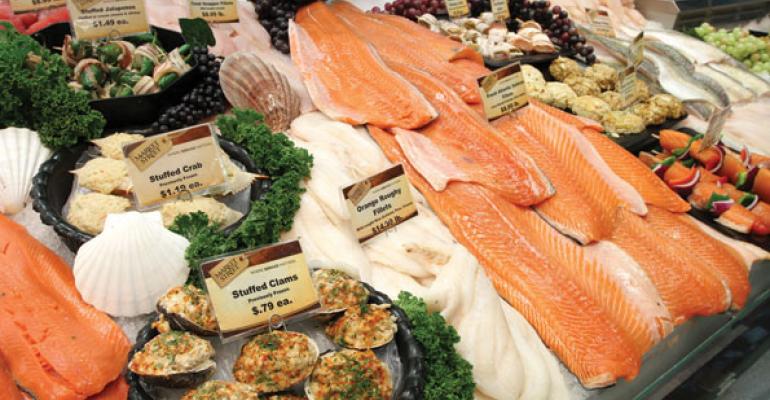
The key word in seafood departments these days is convenience. Consumer demand for quick and easy meals has changed how retailers prepare and merchandise their seafood offerings.
“There’s still a huge intimidation factor [with seafood] and how to cook it, how not to overcook it. So the more a retailer can take away the uncertainty, the better it is to reach a broader range of consumers,” said Neil Stern, a senior partner with Chicago-based consultant group McMillan Doolittle.
Scott Nettles, meat and seafood director for United Supermarkets, Lubbock, Texas, said convenience in seafood grows more important every day.
“The quicker and easier we can make seafood for people, the more apt they are to buy it,” he said.
United is seeing growth in individual and vacuum-packed fish fillets, as well as crusted fish “and the things that people can take home and just pop in the oven,” Nettles said.
Angelo Caputo’s Fresh Markets, an Addison, Ill.-based chain of six stores, sells mostly filleted fish “because people are not accustomed to preparing it or don’t have the time,” said Director of Operations Sam Fantauzzo. “Consumers are looking for a quick-fix for dinner.”
These fillets, along with prebagged mussels, clams and oysters in net bags, are displayed in ice merchandisers for easy pickup.
The Markets, based in Bellingham, Wash., also makes it easy for consumers to buy seafood in a hurry.
Every Memorial Day the chain runs its “Lobster Mania” event in all 17 of its stores, flying in the red-clawed crustaceans from the East Coast to serve raw and cooked outside stores.
The annual event — feted with a huge tent, balloons and signage — draws hundreds of local seafood fans eager for not only the lobsters, but also salmon, shrimp and other fresh seafood.
Throughout the summer The Markets also sells seafood outside, to boost sales and make the ocean’s bounty as convenient as possible for shoppers to purchase.
Inside stores, retailers are offering a wide variety of frozen seafood products to make meal planning and storage of seafood simple.
“Frozen seafood has really grown in the past couple of years, mostly for convenience,” Fantauzzo said.
In fact, he added, frozen sales constitute about 40% of all seafood sales at Caputo’s.
“The convenience factor is what consumers appreciate, and these packages are resealable,” he said. Especially, he added, for shrimp, which consumers can remove from frozen packages by the handful as needed, keeping others frozen.
Shoppers are also aware that frozen fish is often extremely fresh since it’s been flash-frozen at sea, Fantauzzo pointed out. “I believe it’s one of the real lures that consumers are latching on to.”
About a third of salmon sales are frozen at the five Town & Country Markets and Central Market stores in the Seattle area, said Chris King, the independent’s seafood specialist.
The retailer’s bulk bins also offer more than 40 varieties of frozen product, and fresh seafood is portioned and prepackaged so customers can easily buy and cook it.
In addition to resealable packages and frozen seafood, PCC Natural Markets in Washington state goes one step beyond that, said Eli Penberthy, who manages the sustainability of PCC’s seafood departments.
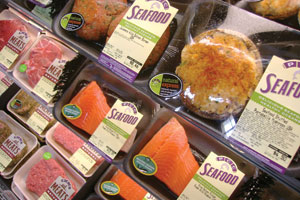 PCC offers a program called Natural Express (left), with value-added seafood offerings such as preseasoned fish with three standard flavors — garlic, herb and teriyaki — plus other flavors that rotate.
And, PCC makes sure its value-added seafood is the same quality as its fresh and frozen offerings. “We have really strict standards,” said Penberthy. “It just means this seafood is easy to prepare when you get home.”
United Supermarkets also offers high-quality, value-added seafood, such as potato-crusted cod fillets that can be baked in just 15 to 20 minutes, or shrimp-stuffed jalapenos that can be simply grilled until heated through.
Providing information to customers at the point of purchase also makes buying seafood more convenient, so they can gather information, cooking advice and recipes all in one place.
Point-of-Purchase Information
Demonstrations and tastings of easy-to-prepare seafood dishes illustrate to customers how convenient seafood can be and how quickly it can go from the refrigerator to the table.
PCC provides cooking information and recipes in its store newspaper, magazine, website and classes. And while PCC includes some complex recipes, “we do talk about how easy [seafood] can be to cook,” Penberthy said. “We try to alleviate people’s fears about fish by offering simple recipes that they can cook at home.”
Town & Country runs regular culinary demonstrations in all five of its stores at least once a week, so customers can taste the seafood and get ideas for dinner. King said these classes are highly impactful on customers.
And while these live demonstrations are easy for customers to access, Town & Country makes it more convenient still: The culinary demonstrations are available on the retailer’s website, including videos that show how to debone salmon, how to clean and store mussels, and how to make grilled salmon salad with raspberry vinaigrette.
Jim Hertel, managing partner at Willard Bishop, a consulting firm in Barrington, Ill., pointed out that tastings and demos “create interest, excitement and traffic that stimulate shoppers well beyond the sampled/demoed items.”
Plus, communicating with customers verbally and with printed materials is essential, he said.
“So, POS combined with service department personnel ‘coaching’ does the best job of all,” he explained.
“That said, it’s more likely that POS will offer the right message consistently for most retailers unless they have superior training and very knowledgeable and engaged in-store associates,” he added.
Bringing in products from other departments to the seafood department can also make shopping and cooking for dinner convenient and fast for customers.
“Seafood is the least visited perishable counter so anything you can do to get more penetration in the category is good,” said McMillan Doolittle’s Stern. “The retailers who are really well put together, value add and put it all in the same area so the customer can easily shop and see what options are available.”
To this end, Caputo’s puts a lot of focus on cross-merchandising techniques.
The stores’ displays include marinated fillets, smoked fish, fresh limes, lemons, bell peppers, wines, breadings, seasonings, herbs and accessories such as wooden skewers for kabobs.
“If you’re aggressive with your merchandising your sales will stay steady,” Fantauzzo said.
Caputo’s even uses its ads to cross-merchandise and make shopping easier to plan. The seafood portion of the print ad includes a photo of a bottle of wine that pairs well with the promoted fish.
“It does fairly well and gets customers to try wines they would not have normally,” Fantauzzo said.
United Supermarkets cross-merchandises grocery items, spices, sauces and dips.
Nettles said United offers nonfood department items in the seafood department, like thermometers, skewers, crab leg cracking tools, shrimp deveining tools and oyster knives.
“We have extensive wine and beer offerings in the department to pair with any seafood dish — many of our team members are well versed in wines and will suggest parings,” said Nettles.
“We offer items to help with special occasions like cedar planks for grill fillets and smoker bags for smoking the fish — team members are also informed and excited to speak about these items that take the meal over the top.”
PCC recently had success with offering the cookbook “Good Fish” by local author Becky Selengut.
“We were hesitant to bring in Becky’s book because we have such limited space in our departments, but they’ve flown off the shelves and we’ve had to reorder several times,” said Penberthy. The cookbook likely also helps sell seafood, she added.
