

With an increasing number of specialty cheeses hitting the market and consumers’ interest on the rise, retailers want to make the most of the category.
How best to present their burgeoning selection has them experimenting. Whether to organize their specialty cheese by country of origin, or by variety, or by brand, for example. These are the questions many retailers are asking themselves.
 Dorothy Lane Market organizes cheeses by type, and then by region.
 “We organize by type, and then by region,” Todd Templin, Dorothy Lane Market’s director of beer, wine and cheese, told SN.
“In the past, we had organized the display by country, but we think this works better. It’s more convenient for the customer.”
Templin said it might be easier for Dorothy Lane — a three-unit, upscale independent — to organize by country, “but it’s more important for the customer to have them grouped by variety. If a customer is looking for a blue, he goes to the blues. Then, our cheese associates can open a dialogue to see what else he might want.”
Murray’s Cheese shops within selected Kroger Co. stores also group the selection by cheese family, said Liz Thorpe, vice president, Murray’s Cheese, New York.
“Our intention is to offer both customers and associates good [and easy] reference points.”
Thorpe pointed out that when a customer walks into a store, they know gouda, cheddar, Brie, maybe blue.
“So that’s the way we do it, by style or family. We have nine different styles” in the display, Thorpe added.
“Signage names each group, uses three adjectives to describe it, and names the best-seller in that group.”
For example, one sign says “Bloomy. If you like: buttery, creamy, rich, we recommend: Brie, Triple Cream.”
On the other end of the spectrum from mild to strong-tasting cheese is a family designated “Washed rind. If you like: stinky, creamy, strong, we recommend raclette, Taleggio, Port Salut.”
In addition to the signs pointing out particular families of cheese, Murray’s Cheese shops have placed a card on each cheese that gives its name and a brief description. Notably, the back of the card bears information as well. It tells the cheese’s country of origin, the milk type it’s made from, whether the milk is pasteurized, and offers suggested wine pairings.
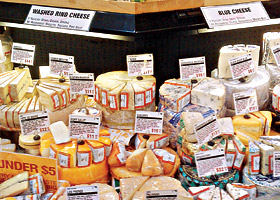 Murray’s shops in Kroger stores include cards with descriptions of each cheese.
 The back-of-the-card information is for the associate and also for the customer. There’s even more information on the scale label.
“We use every square inch of space we can to provide information,” she said.
Despite all of this information, Thorpe pointed out that all of these locations inside Kroger are staffed. Indeed, she said Kroger assigns 150 to 200 hours of labor to the Murray’s stores.
“Ours is a model that’s service-oriented. The expectation is there’s an associate there to explain further and to talk about pairings,” Thorpe said.
Customers at Kowalski’s Markets, St. Paul, Minn., have shown increasing interest in pairing cheese with wines and beer, said Terri Bennis, the nine-unit independent’s vice president of fresh foods.
“Our aim this year — in 2012 — is to focus on pairing cheese with wine. Last year, we had product cards that designated what type of milk the cheeses were made from. We had little symbols of goats, and sheep and cows in the upper right corner of the cards,” Bennis said. “Now, we’ve added a little bottle of red wine or white wine or a beer bottle symbol in the lower left corner of each.”
Offering the pairing tips on the cards is new. They’re being placed in cheese displays this week. Bennis said the addition of more information on the cards and signage, including the new pairing tips, has been customer-driven.
“It’s a result of the regular focus groups we hold with our customers.”
She spoke of a tremendous effort that went into pairing each cheese type with the right wine or beer.
“Hours and days went into making up these cards. Our wine stewards and buyers got together many, many times to find a wine or wines or a beer to pair with a particular cheese.”
Giving pairing information is important, because in Minnesota, wine or liquor stores have to be in a separate building.
“So a customer may have already bought a bottle of wine next door and is now looking for some cheeses.”
At Dorothy Lane, on a Saturday afternoon there may be a cheese tasting at the store’s wine bar (in Ohio, wine can be sold inside the grocery store).
“When we do that, we’ll have a tasting platter with several cheeses progressing from mild to strong, and we’ll match a wine to each, DLM’s Templin explained.
SN has been told that the closer the wine is to the specialty cheese, the better the cheese sales are.
“Our top-selling cheese shop in a Kroger store is right next to a wine shop in that store,” Liz Thorpe at Murray’s said. “That’s the ideal placement, but it’s not always possible unless it’s a new or remodeled store.”
Schnucks' Cheese
Schnuck Markets, St. Louis, organizes its specialty cheese cases by family of cheese, and is currently trying a system developed by New York-based Artisanal Brands. Their Artisanal CheeseClock system offers 16 artisan cheeses in four different colored boxes. The box that houses four 8-ounce wedges of mild cheese is beige. A yellow box contains four 8-ounce wedges of medium cheese. An orange box designates bold cheeses and a red box designates strong cheeses.
The system serves two purposes. First, the color-coding scheme can be used for cross-merchandising wine or beer with neck tags, to help shoppers make the most appropriate pairing. Second, the “Clock” illustrated in point-of-sale materials encourages shoppers to arrange cheeses from mildest to strongest on a plate, and always to try the mildest cheeses first during a tasting, so that their taste buds don’t become overwhelmed.
 The CheeseClock system pairs wines via color coding.
 “We started offering the Artisanal CheeseClock to our customers in April last year in nine test stores, and now we’ve expanded it to 12 stores,” said Charlie Scotino, cheese expert for Schnucks.
“We thought this would be a great tool to assist our customers with cheese and wine pairings,” he added.
“It helps our customers make an easy entrance into the pairing of cheeses and wines, and it assists them in feeling more secure about their choice.”
Scotino also pointed out that the Artisanal CheeseClock concept also can encourage customers to try new cheeses and wines.
Schnucks has 17 stores with specialty cheese shops, but other stores in the chain, Scotino pointed out, offer some specialty cheeses.
The Artisanal CheeseClock system, distributed by Romeoville, Ill.-based KeHe Distributors, has been placed in 125 supermarkets across the country, according to Daniel Dowe, president and chief executive officer of Artisanal Brands.
“We’re expecting to go into 500 additional stores in this first quarter. We’ll be introducing the concept at the [Fancy Food] show in San Francisco next weekend.”
Scotino at Schnucks said it’s too early to know how much of an impact the concept has had on sales of specialty cheese at Schnucks.
“We’ve had less than a year, and we’re evaluating store by store,” Scotino said.
At Foodtown stores, owned by Middletown, N.J., Food Circus, specialty cheeses are organized in the display case by country of origin, but within each country’s section, cheese types are designated.
“For instance, we have these little blackboards and we might write on one that a particular group is made up of soft, ripened cheeses,” said Patty Rispoli, deli manager and cheese buyer/merchandiser, for the 10-unit, family-owned chain.
“You can’t have a thousand little cards in a case. It just will look cluttered. When we have cheeses on sale, we’ll guide customers to them in the case, but with larger signs.”
At Jungle Jim’s International Market in Fairfield, Ohio, an impressive 1,400 different specialty cheeses are called out by country of origin with overhead signs, but are also grouped according to type, said Debby Hartinger, the single-unit retailer’s public relations and marketing coordinator.
“For example, we have 80 different cheddars. They’re in the cheddar section and also in their country section.”
Whatever way they organize or merchandise their specialty cheeses, retailers are enthusiastic about continued growth.
Bennis at Kowalski’s said they’re still experiencing yearly double-digit sales increases, and Thorpe at Murray’s said most of the category’s sales potential generally still lies ahead.
“We’re not even cresting the waves yet,” she said.

