What is in this article?:

- Data Deluge Creates Privacy Issues
- Strange Bedfellows
- The Social Genome
- Don’t Track Me
- Sidebar: Advice from the FTC
With an increasing volume of information available, when does collecting personal data for marketing purposes become an invasion of privacy?

As Bozzuto’s, a wholesaler in Cheshire, Conn., that has five corporate stores, delves into the intricacies of mobile marketing, “the biggest question we are asking internally is ‘What’s the difference between clever and creepy?’” observed Steve Methvin, the company’s vice president of retail technology/e-commerce.
Steve Methvin, vice president of technology/e-commerce, Bozzuto'sUp until the explosion of mobile and social media, food retailers mainly abetted their marketing efforts with data derived from loyalty card programs that linked itemized purchases to a shopper’s identity. Some privacy advocates objected to retailers using this data, but shoppers usually accept this level of tracking as a reasonable trade-off for more relevant promotions.
Now, however, retailers are entering a realm where they may be privy to not only a shopper’s prior purchases, but their location in or near the store, their social media interactions, their online activity and their physical image — a growing stream of information that goes by the name of “Big Data.” The ground rules for how retailers should use this data have yet to be written, and they are often left debating where the line between value-added personalized offers and discomfiting intrusions of privacy should be drawn.
“Privacy is a massive concern, one that if you don’t do it right can cause a tremendous amount of pain for everybody concerned,” said John Caron, vice president of marketing, Catalina Marketing, which manages Ahold USA’s mobile Scan It! application.
Read more: Retailers Confident of Data Security Says Report
Just last week search engine giant Google was asked to change aspects of its global privacy policy after a French agency, the National Commission for Computing and Civil Liberties, found that Google’s combination of data from services such as YouTube, its Android mobile operating system and its search engine could compromise personal data, according to a report in the New York Times. The request was endorsed by all 27 European Union countries, plus Canada and some countries in Asia.
GPS-enabled mobile phones, constantly telling the world “Here I am,” pose particular risks for retailers and consumers. For one thing, the devices can announce a shopper’s arrival at a store, enabling a retailer to send a message that delights or dismays, depending upon the shopper. “A text like ‘Happy Birthday – drop by the deli for a free cupcake’ may sound like a great idea in the marketing war room,” said Methvin. “But on the store floor, it may be an unwelcome invite.”
In general, retailers should be very careful with life-event marketing, even a welcome-to-the-neighborhood message. “Maybe they lost their house and don’t like the new neighborhood,” Methvin said.
Mark Rasch, director of cybersecurity and privacy consultant, CSCCertainly, informing shoppers of the parameters of mobile tracking and marketing – and asking them to approve or opt-in as well as enabling them to easily opt out – is an essential part of any program. “Any mobile message should allow for an immediate ‘STOP’ function to get out,” Methvin noted. A consumer is also entitled to know what personal data a retailer is collecting and whether it is being sold, said Mark Rasch, director of cybersecurity and privacy consulting for technology consultancy CSC, Falls Church, Va. “The more data you collect, the more data you have to account for.”
Message frequency can be another pitfall in mobile marketing. Because these tools are automated, they can become an irritation to shoppers who have their shopping trip interrupted three times by a “special offer.” Over the course of a week, a mobile promotion before the weekend is good timing, as well as one other special offer, Methvin said. “This seems to be the limit. A third promotional message would be pushing the privacy button.” On the other hand, frequent recipe messages are a great use of the tool, he added.
Read more: Online Grocery Shopping Forecast to Grow 9.5% Annually
Time of day is yet another potential problem area; there are expected times for digital messages related to food and shopping, said Methvin. He advises retailers to stick to daylight hours — “anything late or after hours should be taboo.” In one example he provided, Robert’s Food Center, Madison, Conn., texted an offer — at 10:34 a.m. — for a free bag of Dole Yukon Gold potatoes with a minimum $25 order.
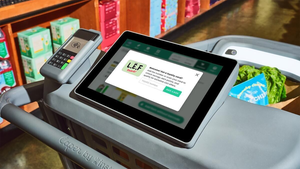
One retailer that has been especially proactive with mobile marketing is Ahold USA, Quincy, Mass., whose Stop & Shop division has ported the Scan It! shopper application from an in-store scanner to a smartphone app in 270 stores. The Scan It! functionality, including scanning and in-store, location-based targeted marketing, was developed, and is managed, by Catalina Mobile (previously Modiv Media), a division of Catalina Marketing, St. Petersburg, Fla.
Catalina Marketing’s Caron explained that Catalina uses a shopper’s store location (as well as purchase history acquired via the loyalty program) as triggers to send targeted offers to shoppers, but does not capture the location data or store it in a database. In addition, Catalina does not sell purchase data on shoppers to anyone, he said. “We control and manage the data on behalf of retailers and brands.” Moreover, while Stop & Shop possesses a shopper’s information by name, Catalina and its brand partners only get ID numbers associated with shoppers in order to fashion offers and send them to a shopper’s phone, he said.
What ultimately will enable retailers to gain shoppers’ trust, Caron said, is providing then with deals that are “valuable and relevant” in exchange for their personal information. Retail-branded mobile apps, as opposed to the third-party variety less familiar to shoppers, help to build that trust, since they are used to allowing retailers to hold their loyalty card data, he added.