

Refrigeration can truly be said to be at the heart of a supermarket’s business — not to be trifled with — which makes what Sobeys is doing fairly remarkable.
Canada’s second largest food retailer, Sobeys, Stellarton, Nova Scotia, is in the process of converting all of its refrigeration systems to something that has never been tried before in North America on a large scale — a “transcritical” refrigeration system that uses carbon dioxide as its only refrigerant.
If it succeeds, this closely watched implementation could have a major impact on how food retailers in North America refrigerate food.
Carbon dioxide, or CO2 (R-744 in refrigeration lingo), is an abundant, cheap and harmless gas that is fundamental to life. It was actually one of the first refrigerants in early-model systems, circa 1900, reaching a peak of utilization during the Roaring ’20s. But as refrigeration evolved, synthetic refrigerants proved more efficient and CO2 was relegated, seemingly, to the dustbin of history.
Synthetic refrigerants, however, turned out to be detrimental to the environment in commercial applications such as supermarkets, either hurting the ozone layer (CFCs and HCFCs) or contributing to global warming (HFCs), or both, as they leaked into the atmosphere. By the 1990s, refrigeration engineers were revisiting their old friend CO2.
In the U.S., Food Lion began testing CO2 as a “secondary” refrigerant in low-temperature applications (frozen cases) at a store in Montpelier, Va., in 2006. Over the next few years, the chain added another secondary-loop test and three stores that employed CO2 in what are called cascade (or subcritical) systems. Other retailers, such as Price Chopper, Fresh & Easy Neighborhood Market and Stop & Shop, have also tested cascade systems in recent years, and the interest in those systems is growing. But in both secondary and cascade systems, CO2 is often used in conjunction with synthetic (HFC) refrigerants, albeit in smaller quantities.
Around 2005, the transcritical system made its debut in Europe, with the distinction of using only CO2, eliminating all other refrigerant gases that, upon leaking into the atmosphere would contribute to global warming or deplete the ozone layer. The system has since been adopted by retailers in the U.K. and other northern European countries. However, the transcritical system operates sometimes at comparatively high pressure — especially in warmer temperatures — which has impeded its adoption in North America. And there are still questions about its relative energy efficiency.
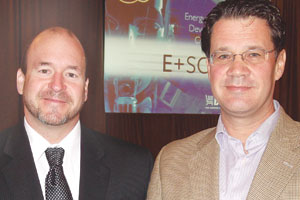 In July 2006, Sobeys decided to try its hand at a CO2-only transcritical booster refrigeration system at a store in Quebec, the first such deployment in North America. Since then the company, which operates more than 1,300 stores across Canada (some as franchises), has become the de facto leader of transcritical refrigeration in the North American supermarket industry. Sobeys now operates 23 IGA stores in Quebec (out of 260) with transcritical systems, including 20 new stores and three retrofits of existing locations, and the company expects to have about 31 transcritical stores by year’s end, including six retrofits, said Simon Bérubé, senior director of engineering and commercial development for Sobeys Quebec, pictured at right in the photo that also includes Sobey's Luc Duprey during their appearance last fall at Food Marketing Institute’s Energy & Store Developement Conference.
Sobeys also has nine stores with cascade systems, but going forward the company plans to install only transcritical systems in new stores, as well as retrofit all existing stores, with a goal of being deployed chainwide with transcritical in 15 years, said Bérubé. Sobeys’ franchised stores are not obligated to switch to the new system, though so far they have all accepted it.
Sobeys is now at the final stage of its commitment to CO2-based transcritical refrigeration, having gone stepwise through a series of improvements over the last few years. “This is where we want to stand,” said Bérubé. Its current transcritical design “is the solution for our climate here. It is meeting our entire vision.”
Growing U.S. Interest
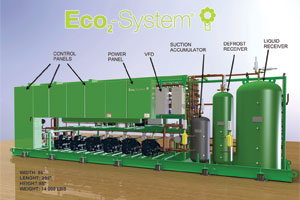
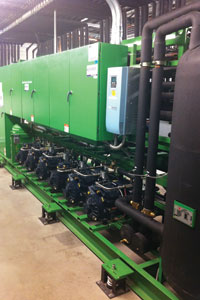
Though it’s the first North American retailer with transcritical systems, Sobeys has been joined by other Canadian retailers, such as Overwaitea and Metro, according to Luc Simard, senior engineer, CSC, which supplies transcritical refrigeration equipment (pictured) to those retailers as well as Sobeys. Another Sobeys supplier, Carnot Refrigeration, has two other transcritical installations under way in Canada, and one in the U.S., said Marc-André Lesmerises, vice president of engineering for Carnot.
One of the key stumbling blocks to U.S. implementation has been the absence of UL (Underwriters Laboratories) approval for transcritical compressors due to the high-pressure issue. However, UL approval is expected to come this year for compressors made by at least two U.S. manufacturers, said Simard, who now orders his transcritical compressors from Europe. “This will change the availability of transcritical systems for the U.S. market,” he said.
 With the UL issue almost resolved, there is an increasing focus on transcritical systems by U.S. retailers. For example, Fresh & Easy Neighborhood Market, El Segundo, Calif., is “evaluating the opportunity” to test a transcritical system, and could do so early next year, said Steve Hagen, procurement and engineering director for the chain, a division of U.K.-based Tesco, which uses transcritical systems in the U.K. “I think in mild climates, transcritical is the future of the industry,” he said. “CO2 is a natural refrigerant, so you won’t have to worry about it being phased out.”
Fresh & Easy is one of the food retailers in the Environmental Protection Agency’s GreenChill Advanced Refrigeration Partnership that have expressed “a lot of interest in CO2 transcritical systems,” according to a statement supplied by the EPA. “Some GreenChill partners are working on CO2 transcritical pilot projects,” the agency said. “Many are thinking about transcritical systems, but they may be holding back and waiting to see what others do.”
Executives from Hill Phoenix, Conyers, Ga., which also supplies refrigeration technology to Sobeys (though not yet transcritical equipment) and many U.S. retailers, also see interest in transcritical expanding in the U.S. “There are a bunch of retailers that want to be first,” said Scott Martin, director of advanced engineering, Hill Phoenix. Queries are coming from both warmer and cooler climates. “There’s a retailer that wants to put one in Southern California,” he said. Rusty Walker, senior trainer with the Hill Phoenix Learning Center, said in a recent GreenChill-sponsored webinar that a transcritical system is being installed in the New York area this summer.
 Part of the interest in CO2 refrigeration derives from a desire by a many retailers to move away from using HFC and other fluorinated refrigerants for environmental reasons, since they are from 1,500 to 4,000 times more potent that carbon dioxide as a greenhouse gas contributing to global warming. For example, while CO2 has a global warming potential of 1, R-404A’s GWP is 3,922. So-called F-gases, which include HFCs and HCFCs, are projected to be responsible for 9% to 19% of annual greenhouse gas emissions by 2050, according to the U.K.-based Environmental Investigation Agency.
In November 2010, at the Cancun Climate Summit, the Consumer Goods Forum, Paris, a group of about 400 global retailers and CPG manufacturers, pledged to begin phasing out HFC refrigerants by 2015 and replace them with non-HFC refrigerants, such as CO2, other natural refrigerants and other low-GWP synthetics. “This is the first time that the entire sector has aligned around the importance of taking action to accelerate the move to climate-friendly refrigeration,” said Lars Olofsson, chief executive officer of French food retailer Carrefour, and Muhtar Kent, CEO of Coca-Cola, in a statement at the time. Other Forum member companies associated with the pledge include Ahold, Delhaize, Wal-Mart Stores, Sobeys, Tesco and Metro.
And at the 23rd Meeting of the Montreal Protocol Parties last November, EPA and the U.S. Department of State announced that 108 countries signed a declaration to address HFCs.
The adoption of non-fluorinated refrigerant is still in its infancy in the U.S., though interest is growing fast, said the EPA. “Some GreenChill partners are considering non-fluorinated refrigerants with low GWPs as a long-term solution,” the agency said. Carbon dioxide is the most prevalent of the non-fluorinated refrigerants in U.S. supermarkets, mainly due to its use in cascade and secondary systems as a low-temperature secondary fluid, rather than as a primary refrigerant.
The Energy Question
Beyond the direct environmental benefits of employing CO2, pioneers of transcritical systems like Sobeys are finding them to be more energy (and therefore cost) efficient than traditional DX (direct expansion) refrigeration systems using synthetic refrigerants. While this energy efficiency is well-documented in moderate climates such as those in which Sobeys operates, the question remains whether it can be duplicated in warmer climates farther south.
Sobeys, in a comparison of three transcritical stores to 22 conventional stores using R-507 or R-22, found the transcritical systems required 18% to 21% less energy, said Bérubé. All of the stores in the study have the same size (45,000 square feet) and construction. “We are comparing apples and apples,” he said.
Short-term warm weather doesn’t appear to be a problem; the last two summers in Quebec were among the hottest ever “and we had less concerns with the CO2 stores than with the conventional stores,” said Bérubé.
A separate study by manufacturer Danfoss determined transcritical systems offered an 18% energy savings in Quebec, a 6% savings in New York and no savings in Atlanta, compared to an R-404A reference system.
Sobeys’ 18% to 21% energy savings “is a pretty bold energy number,” said Hill Phoenix’s Martin. “I wouldn’t say it’s going to be that much for everybody.” But in a colder climate, a 10% energy savings is a safe estimate, depending on what technology and refrigerant it is being compared to, he added.
According to Hill Phoenix’s Walker, transcritical systems currently operate 5% to 10% more efficiently than DX systems using HFC refrigerant in climates with an average annual temperature under 50 degrees Fahrenheit, such as the northern U.S. and Canada. In climates with an average temperature between 50 and 59 degrees (roughly the horizontal mid-section of the U.S.), transcritical systems are at energy parity with conventional systems, and in southern climates above 59 degrees, the system has to be evaluated on a “case by case” basis, he said.
Ron Vogl, technical marketing manager for Honeywell Refrigerants, cautioned that in comparing the energy consumption of a transcritical system to that of a conventional system, a thorough understanding of the baseline conventional system is needed, including design factors unique to a location. Often the baseline system in many of these comparisons is a “non-optimized, cost-influenced design,” he said.
“If you’re a supermarket chain, you probably should explore some new technology and some CO2 does make sense,” said Vogl. “But with transcritical, if you have temperatures above 50 degrees Fahrenheit, you will be hard pressed to compete energy-wise with a very basic R-404 system.”
For warmer climates, Hagen believes that the combination of ammonia and CO2 “is going to be a great option.” The EPA has allowed ammonia to be used as the primary refrigerant in secondary commercial refrigeration systems. Fresh & Easy expects to open an ammonia/CO2 store late this year or early 2013.
Some observers point to research and development efforts that are improving the ability of transcritical systems to operate efficiently in a warmer environment. “If all of [the refrigeration manufacturers] go after it from a research standpoint, we can make the transcritical system as or more energy efficient than existing systems,” said Martin. But it’s in the early development stages.”
Simard expects transcritical systems to be made suitable for the entire U.S. in less than two years. Meanwhile, transcritical systems can work efficiently in warm climates “with low wet bulb temperature values [drier conditions] using adiabatic cooling.”
Thinking Differently
Some U.S. retailers believe the solution to the emissions of HFC refrigerant is not to replace the refrigerant with CO2 or another low-GWP gas, but to simply tighten the refrigeration system so that the leak rate approaches zero. Retailers in the GreenChill program, for example, have succeeded in lowering their leak rates dramatically. But Bérubé questions how long a leak-tight system can remain that way. “I have stores with a 0.5% leak rate, but over the next 20 years that will increase by 100% for sure because of the aging of piping and the vibrations,” he said.
Sobeys decided to commit to transcritical systems “to find a solution for our increasing maintenance costs and leak costs,” he said. “We had tried a lot of things, such as improving the leak tightness of the system. But we decided we have to think differently.”
Sobeys initially tested cascade systems, partly to quiet the fears of upper management about making the leap to a new technology and refrigerant. But cascade systems, which pump glycol or CO2 through the cases as a secondary refrigerant and holds CO2 to a low pressure and temperature, “don’t meet our expectations on the energy consumption side,” Bérubé said.
 The vision Sobeys has for its transcritical system — which it began realizing two years ago — encompasses a simpler, smaller design with far fewer compressors. It uses no HFCs, and has half the maintenance costs, lower energy consumption and an equal or lower initial cost, Bérubé said. It takes advantage of a less expensive refrigerant in CO2 ($1 or less per pound, compared with $12 per pound for many HFCs), uses almost half as much refrigerant and also leaks less because of the simplicity of the system.
The installation cost is less because the copper piping has a smaller diameter (an inch or less compared with three inches). It uses electronic valves and controls that meet the needs of the cases — temperature, defrost and energy management — in real time, improving the quality of product on display and helping to moderate the temperature of the store. The electronic valves add to the initial cost of the system, but bring energy cost savings in the long term.
The transcritical system also generates a large amount of heat, all of which can be reclaimed for space and water heating, adding to the efficiency of the overall system. Heat reclaim is a definite advantage of the transcritical system, said Honeywell’s Vogl. “If you can use all the heat that the system makes, it does give you a little benefit.”
Sobeys has received $15 million in rebates from Hydro-Quebec, and $125,000 per project in grants from Canada’s Office of Energy Efficiency to support its transcritical implementation, but that was “the cherry on top,” not part of the cost calculation, said Bérubé, adding, “We still have some subsidies but it won’t last forever.”
Last fall, Sobeys was able to directly profit from its green refrigeration initiative by selling 15,000 tons of carbon credits to the National Bank of Canada. “It was an interesting transaction for the bank and us — we’re both happy,” said Bérubé, who declined to cite the cost of the carbon credits. “It’s another added value for us to go to these new technologies.” All told, Sobeys, which is a participant in the Western Climate Initiative, has 100,000 tons of carbon credits it could put on the carbon market, he added.
Not everyone concurs with Bérubé’s assessment that the initial cost of the transcritical system is equal to or less than that of a conventional system. Fresh & Easy’s Hagen regards the cost of transcritical systems as a drawback, “but with more acceptance and volume, costs will decline and the lifecycle cost could become comparable.” And Carnot’s Lesmerises said that retailers will “pay more for the transcritical rack, but less for installation.” With the energy savings, lower maintenance costs and cheaper refrigerant, “they will save in a short period of time,” he added.
Bérubé acknowledges that CO2 can’t be simply “dropped in” with a few modifications as a replacement for R-22, which is being phased out in the U.S. and Canada. (See the R-22 refrigerant shortage story here.) Sobeys still uses R-22 in more than 100 stores. But the retailer is determined to make the investment in retrofitting aging refrigeration systems with CO2-based transcritical technology.
Sobeys plans to keep stores open during the retrofit process. It can do that because the transcritical compressor rack is compact enough to be installed in the machine room next to the original rack so that the changeover can be made “one line at a time,” Bérubé said. A retrofit requires upgrading the evaporator and valves in the chilled and frozen cases, as well as installing narrower copper piping in the store, though Sobeys is “challenging our suppliers” to do the retrofit with the original piping. Standard cases can be used as long as they are rated for 600 pounds per square inch (psi), said Simard.
Sobeys has used another natural refrigerant — ammonia — to refrigerate its warehouses, switching in 2008 to a smaller quantity of ammonia in a new energy-efficient warehouse in Trois-Rivieres (Three Rivers), Quebec, in concert with glycol. “At Three Rivers, I was able to demonstrate to my top management that since we built a big warehouse with no HFCs, so why not build a store with no HFCs?” said Bérubé.
Managing Change
Bérubé cited “change management” as the biggest challenge in the implementation of the transcritical system. “You have technical people, middle management and marketers who retain their way of doing business,” he said. “That will change over time.” It helps that top management “wants this solution to be deployed,” he added. Simard noted that training technicians to handle the electronic components of the system can be a challenge.
Bérubé downplayed the often-expressed concerns about the high pressures that the transcritical system operates under when cooling medium temperature cases, particularly in warmer weather when the outside temperature reaches 88 degrees Fahrenheit (the critical point of CO2), with a pressure of 1,067 psi. In the parts subject to the higher pressure, which ranges from 800 to 1,300 psi, the system is protected by stainless steel piping that can withstand seven to eight times the operating pressure, he noted.
When the temperature reaches 88 degrees, CO2 enters the “supercritical” or transcritical state in which it no longer operates like a normal gas in that it no longer condenses directly to a liquid. The system is designed with a gas cooler, gas bypass valve and high-pressure valve that bring the temperature of the CO2 down so that it can become a liquid and then enter the normal evaporation phase that chills and freezes food. The energy penalty in the system largely occurs as the system grapples with the supercritical state.
Simard noted that there have been at least three pressure-related accidents in transcritical systems in European stores. But the accidents were related to the use of compression settings that are not used in North America. “There was a big boom, but it just gave out dry ice that looked like snow and nobody was hurt,” he said.
“In 2012, 2,000 pounds of pressure is nothing,” added Simard. “The hydraulic power steering in your car has pressure like that — around 1,500 psi.”
In order to maintain the high pressures in the event of a power failure, a back–up generator is considered necessary for a transcritical system. Sobeys uses a large generator in most of its stores to accommodate the entire store. The CSC system only needs a 7-kilowatt generator, which costs around $2,000, said Simard.
By contrast, traditional DX refrigeration technology is notable for its compressor redundancy, said Vogl. “You could have multiple compressor failures and you’re still in the frozen/refrigerated food business.”
In a presentation he made at FMI’s Energy & Store Development Conference, Bérubé concluded by pointing out that a major leak in a conventional synthetic refrigerant system would have the same GWP as driving 1,200 cars on the road for a year; on the other hand, a major leak in a CO2 system would have the same GWP impact as a “solitary fisherman using his motor boat on the lake.”
He encouraged the retailers in the room to “change the world” by looking into the new CO2 transcritical refrigeration technology, which he insisted was “not the technology of the future — it’s today’s technology.”