
LAS VEGAS — Winning the Thomas K. Zaucha Entrepreneurial Excellence Award means a lot to Archie McGregor.
“Being recognized this way has to be the biggest event that’s happened to me in my life,” McGregor told SN. “I’ve received awards over the years, but when I was told about this award, all I could say was, ‘Wow!’
“It came as a total surprise that I would even be considered for an award like this.”
McGregor, who operates two Archie’s IGA stores in the Pacific Northwest, was scheduled to receive the award here Saturday night at the NGA board of directors’ dinner, the day before the start of NGA’s annual convention.
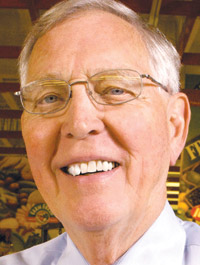 Peter Larkin, NGA president, told SN McGregor (right) was an obvious choice for the Zaucha Award “because he exemplifies the entrepreneurial spirit that makes independent grocers the backbone of our industry.
“He has two stores in two communities, and each is tailored to meet the needs of that community. He understands the need to differentiate and to respond to his separate markets — something I saw with my own eyes when I toured his stores.
“As with many other independent grocers, he has supported local community causes for years, and walking his store in St. Maries with him, it was clear he is regarded as a pillar of that community.
“He’s also been very involved with IGA and the Coca-Cola Retailing Research Council, and he proves that a one- or two-store grocer can achieve great heights in the industry if he is willing to be a leader — and Archie McGregor is a leader.”
The Zaucha Award — named for the man who headed the National Grocers Association for its first 27 years prior to retiring in 2010 — recognizes retailers who have shown tangible examples of persistence, vision and creative entrepreneurship during their food industry careers.
McGregor said he has met Zaucha on a couple of occasions, “and he’s been one of my inspirations — and I believe he will continue to be an inspiration to independent operators that have known him or who will hear of him through this award.”
Local Pulse
According to McGregor, the future for independent operators is bright “because they are more involved within the communities they serve; they are committed to giving local shoppers the goods and services they want; and they are committed to supporting local activities.”
McGregor started his grocery career in 1957, when he went to work for his father, who owned a single store in the Spokane, Wash., area. When his father sold that store in 1960 and bought a motel with a convenience store on the same property in Coeur d’Alene, Idaho, McGregor continued to work with him before those businesses were sold, after which he went to work for Albertsons for six years.
Recalling that experience, McGregor said, “It was a great organization for training people, and I learned a lot about having good maintenance programs, good follow-through and getting new items on the shelves.
“But I also learned about the ins and outs of how a chain operates, especially with regard to the gap between the time an opportunity arises and when a decision is finally made after it goes through the system.
“As an independent you must not be afraid to make decisions as fast as you can, and you’ve also got to make sure you stay in touch with your customers on a very personal basis.”
In 1986 McGregor had an opportunity to acquire a 26,000-square-foot IGA store in St. Maries, Idaho, that had been closed — a store he called Archie’s IGA after soliciting local opinion.
He acquired a second store — Glenwood IGA, a 15,000-square-footer in the Glenwood neighborhood of Orifino, Idaho, near Lewiston — a few years later but sold it two years ago after operating it for five years. “It didn’t fit our mold,” McGregor explained.
In 2004 he acquired another location — a 43,000-square-foot store in Pullman, Wash., that was called Dissmores IGA, a name he retained because of its local equity.
The company is looking for additional stores, he noted.
Besides the size difference, the company’s two stores differ in scope from one another, McGregor pointed out. “The store in Pullman is near Washington State University, so it’s in a college community, and our events there are built around the college to some degree — though while students come and go, there’s still a base community there that we have to please.”
The store has a post office, and in the last two years it’s leased space to a Chinese chef who prepares Chinese food and sushi, “which gives us a unique offering,” he noted.
In contrast, the store in St. Maries (pronounced St. Mary’s) is in a lumbering community, “and customers tend to drive longer distances from satellite communities 10 to 20 miles out to shop there,” McGregor said. “In fact, we are the largest market serving the area.
“Besides providing customers with what they want in terms of food, we’ve added an in-store bank and a Subway as part of our deli — and we even had a J.C. Penney catalog store there for eight years.
“We also provide Western Union service, and we’ve developed a program that made our store a drop-off point for Federal Express, which was going to pull out of St. Maries altogether before we stepped in.”
Economic Impact
The economy in the Pacific Northwest has taken its biggest hit in the area of housing, which has hurt the store in St. Maries more than in Pullman, where the student population keeps sales going, he explained.
“People in St. Maries are still struggling because there’s been very little new construction in the region. As a result, we see customers trading down to private level. IGA has a strong private-label brand, so we’re fine in that area.
“But we also see customers no longer buying ahead on sales, though we cleaned up well during the holiday season, which tells us customers are looking at doing nice things for family occasions.”
He said the store has also seen an increase in sales of high-end wines. “It used to be the low-end wines that were selling, but in the last couple of years we’re seeing high-end wines selling better — apparently because people are eating at home more rather than going out to restaurants or entertaining more at home and they want to treat themselves and their guests to better wines.”
One area in which McGregor believes his two stores are improving is in their use of technology.
For example, the company installed an accounting system in January from Financial Management Services “because we felt it would help us determine what our labor costs should be vs. our peer group and what kinds of sales and profits we should be getting in individual departments,” he explained.
The stores have also installed Revionics to do price monitoring and also to keep track of product movement vs. movement among competitors, “and it helps us keep our gross margins in line by category,” he added.
Training Programs
McGregor said he is also utilizing training programs available through IGA’s Coca-Cola Institute. “Those programs help employees who may not have sufficient expertise to answer customer questions, whereas after they’ve finished the courses, they are able to provide detailed information.
“So the training not only gives employees more confidence, which contributes to their longevity with us, but it also builds a better relationship between employees and customers.”
Two of McGregor’s five children have joined him in the business — oldest son Archie and youngest son Brian — “and that makes me very proud,” he said.
Archie McGregor 3rd joined the company after graduating from college. “We had just put in computerized front-end registers, and I really hadn’t worked with those, so I asked him if he would stay and help, and he did,” McGregor recalled.
“And when Brian, graduated from college, he said he’d like to come into the business, and an opening was there. So it’s been really nice. Archie enjoys the IT part of the business and he also oversees equipment, and Brian enjoys the marketing and sales part of the business, so they really complement each other.”
At age 75, McGregor has stepped away from day-to-day operations and left his sons in charge. “They make different decisions than I might have made, but that’s part of the generational change,” he explained.
“The biggest part of passing control to the next generation is keeping the lines of communication open so they will talk to you, but you have to respect whatever they choose to do, both in business and in life.
“Whenever something comes up, they always call me and we talk about most decisions. I give my opinions for them to consider, and then they decide what they want to do, which is fine with me. So it’s been a good transition.”
The decision to invest in Revionics, for example, was made by his sons on their own, McGregor pointed out. “I challenged them and questioned whether that system would really change the way we price, but now I believe they made the right decision.”
It isn’t clear yet if a fourth generation of McGregors will join the business, he said, though one of his 12 grandchildren — Megan Tracy — majored in marketing at Loyola University in Chicago and then did an internship with Willard Bishop, Barrington, Ill., before joining the marketing team at IGA, he noted.
Special Projects
McGregor spends his time working on special projects for the business, he said. Right now he’s reviewing all vendor programs, including pricing, new item distribution and markdowns, “to make sure we are maximizing our opportunities,” he explained.
The project started in December with meetings with Supervalu personnel, “and now that we’ve identified which programs are most beneficial to us, we’re in Phase 2, in which we’re trying to prioritize programs, looking for the best opportunities to maximize our customer counts, sales, bottom line or, hopefully, all three.
“Once we’ve made those determinations, Phase 3 will involve meeting with our department people to let them know how we want to move forward.”
McGregor said he’s also involved with IGA — serving as a director of IGA USA and as chairman of the National Retail Advisory Board, which provides the U.S. arm of IGA with suggestions on how to improve the value of the alliance to its retailers.
In addition, McGregor is active on the Northwest IGA board, which oversees activities in Washington, Oregon, Idaho, Montana, Wyoming, North Dakota and Alaska.
IGA is a big help to independents, he pointed out. “An independent usually can’t provide enough of what his customers want on his own, so he has to partner with other independents to exchange ideas, and that’s what IGA does for us.
“As an IGA associate, I can share ideas with IGA stores in other areas and see what they’re doing and learn from them, although each of our stores remains unique.
“We believe strongly in IGA’s slogan, ‘Hometown Proud’ — that’s what the independent is all about in the local community. A chain can serve a wider area, but an independent generally must rely on the neighborhood around his store to support his business.”
McGregor has been a member of NGA for more than a decade, he said, though he’s been coming to NGA conventions since 1986 as a Supervalu customer and IGA retailer, “and I’ve always been interested in the issues the association deals with, such as credit card fees and helping to keep the playing field level for independents — the kinds of issues that are very important to our business.
“I also admire the educational programs NGA offers at its shows, and I always take away an idea or two.”
Ideas he’s taken home from past conventions, he said, include the importance of transition planning, “along with some operational ideas for the stores that I’ve learned at the Harold Lloyd seminars — for example, being aware of how your store entry appears to customers, making sure shopping carts are easily available and making sure you maximize your end displays with tie-in items for extra sales.
“And when I was remodeling one of my stores several years ago, I looked at some of the equipment on display at the show and got some questions answered, which enabled me to select what I wanted.”
Asked how independents have changed since he started in the business 55 years ago, McGregor said, “We no longer have salesmen knocking on our doors. And there’s a lot more reliance on computers and high-tech, and if you don’t keep up with technology, you will be out of business.
“Marketing dollars come to us in different ways now, and manufacturers are more interested in what’s going out the front than what’s coming in the back door.”
Wal-Mart has also changed the way independents operate, McGregor pointed out. “You have to recognize who they are in the marketplace and realize you shouldn’t try to put them out of business. Instead, what they do is force you to look at your own business to see if you’re providing all that your customers want in terms of fresh, selection and service.
“As a result Wal-Mart had made all retailers better operators through greater efficiencies. It has also made all distribution centers more effective, and manufacturers as well.”