

While promoting his new book, “Conscious Capitalism” in New York last month, John Mackey, founder and co-CEO of Whole Foods Market, told an audience that the nation’s largest natural food chain is keeping a “close eye” on what FreshDirect is doing.
It was only a passing comment, but telling nonetheless. Of all the retail entities out there, Mackey chose an online operator that delivers healthy foods sourced from a range of natural, organic and sustainable producers right to the front doorsteps of hungry subscribers.
Many retailers understand, and know exactly what’s piquing Mackey’s interest. There’s evidence everywhere. The number of online retailers selling natural, organic, local and artisan foods and beverages is growing. Several of them have just recently received infusions of fresh capital to help them grow further. They are moving to larger offices and adding staff, as well as customer territory. There’s even talk now of Whole Foods itself getting into the online and home-delivery business.
What was not too long ago an outlet for hardcore lifestyle consumers looking for little-known products has reached a threshold that brings it into the orbit of natural food retailers, farmers’ markets, CSAs — and mainstream supermarkets.
Up, Up, Away
The recent growth spurt in the online retail sector specializing in health, wellness and sustainability can be traced to an improving economy. Investors looking for fresh opportunity are handing over their capital to sites that were founded when wellness was just appearing on the radar of American consumers in the 1990s and early 2000s, and had proven staying power by surviving the crushing 2008 recession.
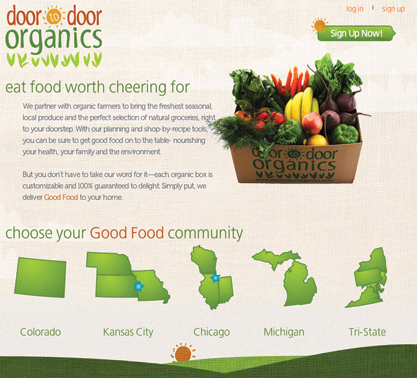 Among the beneficiaries is Door to Door Organics, which received a $2 million buy-in from Greenmont Capital last August. Last month, natural emporium Abe’s Market landed $5 million in funding led by Israeli venture capital firm Carmel Ventures. Richard Demb, co-founder and CEO of Chicago-based Abe’s, said the new money is a sign the financial community knows where the future of food retailing lies. Just follow the shopper.
“Our customer base is now not just a lot of new people but an increasing number of people buying three or four times within a few months,” he said. “So we’re starting to see a jump in frequency.”
The upswing in repeat customers is what tells Demb his site of 12,000 food and nonfood SKUs resonates with consumers. But it’s a never-ending process. Abe’s continually hones its selection and looks for ways to improve its interface.
“We attract an informed shopper who takes a little more time in what they buy and cares about themselves and their families,” said Demb. “That shopper is doing some stocking up at an Albertsons or Shaw’s, but they’re also hitting a co-op, a Trader Joe’s and a Whole Foods along the way.”
Online retailing’s ability to squeeze into that line-up of multiple shopping destinations has been key to its success so far. In an era when more venues than ever are offering food, consumers seem eager to consolidate trips. They’re turning to online retailers for certain products as a convenience, notes Sucharita Mulpuru, vice president and principal analyst at Forrester Research.
“It’s a pain to have to go to all these local merchants,” she said. “If you have the ability to have one order delivered to you, that makes sense.”
Convenience is very much an ingredient in the recipe that propelled e-commerce to sales of $226 billion in 2012, according to Mulpuru, a number that will likely hit $327 billion by 2016, representing 9% of total retail sales. But for all the success, most of the goods sold online are electronics, apparel and toys. The regular purchase of food is something most Americans still do in a store.
“I’ve always described food as the last great frontier in e-commerce,” said Chad Arnold, president and CEO of Door to Door Organics, an online home delivery service based in Lafayette, Colo. “There’s no other $800-billion-dollar industry that e-commerce hasn’t touched yet.”
There have been some false starts and outright failures, but the barriers keeping more consumers from food shopping online are falling away as companies get better at crunching data to improve the customer experience.
“We’ve got different kinds of models out there, and experimentation, and that’s always healthy, because we’re always learning,” observed Nancy Childs, a professor of food marketing at St. Joseph’s University. “And the consumer has more votes in terms of what’s meeting their needs.”
Interaction — that critical component of any retail sale — is being transformed by online retailers. Many analysts cite Amazon, which has been consistently ranked No. 1 in customer service. Some wellness outlets are gaining traction in this area, too.
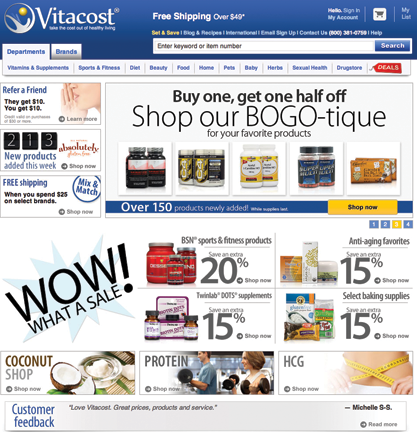 Vitacost, one of the largest online sellers of health and wellness products with 40,000 SKUs, garnered its own award when customer analytics firm ForeSee ranked the company behind only Amazon and L.L. Bean for customer satisfaction during the 2012 holidays. The site heavily promotes its large selection and prices that are up to 50% off retail.
“All of our customers, like all consumers, are very interested in value,” said David Zucker, the retailer’s chief marketing officer. “We believe all of them understand that we offer great products at great prices, and that’s a very valuable proposition — to be able to offer customers brands they’re comfortable with at competitive prices.”
Value is another component that online retail has been able to highlight, even as it redefines the word in the process. At Door to Door Organics, value is found in the carefully curated selection of organic produce, meat, dairy and grocery.
“We’ve stepped back from trying to rebuild the grocery store online,” said Arnold. “We’re thinking more about the fundamentals of the transaction, and building a shopper experience that’s based on the nature of the problem, not on the existing solutions.”
In other words, today’s online food purveyors are teaching people to purchase food by the way they think about food — a recipe or a meal or a lifestyle. It’s no longer about the product.
“In fact, I would argue that the product is an artifact of the retail grocery environment,” added Arnold, whose company just opened on the East Coast serving the lucrative New York-Philadelphia corridor.
Are You Experienced?
For decades, the supermarket reigned supreme as the preferred source for at-home food and beverages. Indeed, today’s national chains were once individual produce stands and meat stores that grew by adding other perishables, dry grocery and service counters. By the post-war 1950s, they had become a one-stop convenience destination. It’s a formula that still influences the way Americans shop today.
“You have an extremely emotional experience when you walk into a store,” said Zucker. “Walk into a Whole Foods, it’s a great experience. You want to shop. But you’re going to pay for it.”
Online retailers may not be able to re-create the physical qualities of shopping inside a store, so they’ve invented new touchpoints.
“They’re specializing and they’re building communities with their shoppers,” said Childs, the professor.
 Visit the Abe’s website and there are plenty of compatriots to talk to, and all the information anyone could want about a product, no matter how obscure. The emphasis is on developing content around each product: Questions and answers, direct queries to the company, user reviews, and fun, yet informative, off-the-cuff videos.
“The average product package has a paragraph of information about it,” said Demb of Abe’s strategy. “We average something like 12 pages of data. The 360-degree picture we can paint for a product is so much deeper than you can find on the retail shelf.”
Door to Door Organics appeals to shoppers looking for local and artisan foods, and by taking advantage of the new sources of information that motivate consumers to adopt a natural/organic lifestyle.
“Inspiration is completely an open social experience now,” said Arnold, with new foods and recipes getting shared on Pinterest, Facebook or even Twitter. “It’s a whole new way of living and shopping.”
Online retail has also demonstrated a remarkable agility that allows it to meet America’s shifting shopping habits much quicker than brick-and-mortar stores. Consumers discovering new lifestyles or changing their diets may not be able to find products that meet their needs at their local supermarket — or so the complaint goes — but a quick search online brings them to a Vitacost or a Door to Door Organics.
The search for solutions has motivated online retailers to reconfigure their websites and introduce new interfaces.
Abe’s reinvented the way its shoppers can search for products by creating Abe’s Qualities, a list of more than 220 lifestyle or product attributes that automatically culls only those products that meet those standards in any category. For example, a mom will be able to find an organic, handmade baby food packed in BPA-free containers by clicking on those three qualities under the Babies & Kids category.
“We’re matching the way they shop to the way they live today,” said Demb. “They say, ‘I’d love to buy more organic, more BPA-free, more hypoallergenic. Abe’s, make it easy for me, show me cool products that are relevant to me. Give me the story behind the product.’”
 Stores can face limitations of space and get caught up in the amount of time it takes to cut in a new product. The setup tends to reinforce old shopping habits that are beginning to chafe consumers.
It’s not that supermarkets aren’t trying. Ahold’s Peapod has emerged as a leading home delivery service that’s pioneering the use of commuter bus stops and movie theaters as non-traditional shopping intercepts. But it remains the only large-scale online shopping division operated by a major retailer.
Applications for smartphones may be the easiest way for brick-and-mortar companies to compete for the online shopper. Wegmans Food Markets, Rochester, N.Y., just unveiled a comprehensive app that’s gotten rave reviews from customers and industry observers alike.
“With the Wegmans app, I can compare the prices of the items on my list with other stores (and come to appreciate Wegs even more!),” wrote one Twitter user, using the hashtag #wegapp.
“Had dinner and did groceries in one hour last night thanks to Wegmans and the new #wegapp,” gushed another.
The app, unveiled in January, includes functions that almost mimic an online shopping experience. Shopping lists can be organized by aisle according to a store’s layout to help avoid backtracking; loyalty card holders can access and view a history of past purchases, “perhaps helping with forgotten shopping list items”; and shoppers now have the ability to download products needed for a specific recipe from the Wegmans’ Menu magazine right onto their shopping list.
Functions such as those provided by the Wegmans app go way beyond the usual options that supermarket retailers currently provide, such as the store’s weekly circular, coupon access, meal planning and cooking tips, and a loyalty card point tracker. Those in the world of virtual food shopping say cogent apps are critical for physical retailers to transition into this new shopping universe.
“If retail doesn’t get in tune with what’s going on with the whole food experience, and how technology is enabling that experience, then they’re going to lose mindshare of the customer,” said Arnold.
Out of the Box
Online retailers admit they also have work to do. For all the convenience and value to be found in web-based stores, humans remain tactile creatures that like to touch, see and smell. It’s an advantage that gives supermarkets the edge as the top shopping destination.
“In many respects consumers want certain things from a store. They have the face-to-face interaction,” said Zucker of Vitacost. “The other thing you get is immediacy. You get it now.”
“No one is going to go cold turkey and quit grocery shopping altogether,” agreed Mulpuru of Forrester. “I think that traditional grocery is still convenient and is hard to beat.”
While the “gotta-have-it-now” mentality entirely benefits brick-and-mortar operators, it hasn’t stopped online purveyors from attempting to find ways around that hurdle, or at least to neutralize its power.
Instead of developing gargantuan plans for same-day delivery, Vitacost is seeking to redefine the problem itself. Its own research reveals a new way to approach consumers.
“The barrier to shopping more for nonperishable items on the web is around people’s ability to plan,” said Zucker. “Not everyone either knows how to do that, or is consistent about it.”
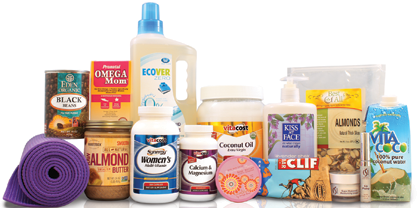
For a site like Vitacost, offering an array of shelf-stable foods, dietary supplements and HBC items, someone who has a better handle on what they need in their pantry on a consistent basis — soups, pasta, rice or cereal, for instance — is a customer that could benefit greatly from ordering online and getting home delivery.
“On a value perspective, if you need oats or beans every week, you don’t need to pay supermarket prices,” noted Zucker.
The concept of free shipping is a double-edged sword for online customers. While they like the idea, they can balk at the spending minimums set by the retailer in order to qualify.
 “Here’s the conundrum. Everybody thinks the consumer wants fast, same-day delivery. And they do want that, but they don’t want to pay for it,” said Mulpuru.
Vitacost can typically deliver within four to seven days, and offers free shipping on orders over $49; the deal is the same at Abe’s Market. At Door to Door Organics, shipping is free for the weekly boxes of produce and any additional items ordered from the other categories available on the website.
“The world is moving towards a place where everybody expects free delivery,” said Arnold, Door to Door’s CEO, adding that building “smart density” and operational efficiencies allow it to take shipping costs out of the equation. Some of the $2 million recently invested will go toward strengthening the supply chain.
“Delivery charges are not something people want to pay for,” he said. Door to Door uses waxed boxes to ship its mostly perishable foods. Box size depends on the amount ordered, and the order can be shipped anywhere the shopper chooses.
If customers do have to fork over money for shipping, online retailers want to make sure they get what they pay for. Companies are embellishing the experience of receiving the shipment, literally trying to re-create the feelings of anticipation shoppers get when they walk through the doors of a supermarket.
“We’ve got a very special box. We see it as another customer touchpoint and a way to build a relationship,” said Demb of the boxes that come from Abe’s. “It’s not just a logo, it’s an activity that includes the whole family. The idea is, how can you reuse this box?”
 Vitacost recently upgraded the shipping containers to better protect the products that are shipped. Boxes are now packed with wine dividers that isolate fragile items and reinforce the structural integrity of the outer carton.
“The dividers improve the out-of-box experience,” said Zucker. “So now when you open it up, it’s a lot more presentable. The flour isn’t on top of the potato chips, and that can of tuna you ordered hasn’t been rattling around inside.”
Abe’s has extended the box experience to a new sampling program called Discover Natural. For $5 (with an identical credit for a subsequent purchase), Abe’s will ship three sample-size products chosen by the customer from a list.
“It’s one way we try to help you not just touch a product, but sample it and give you chance to see if it’s something you want to buy,” said Demb.
The items are nestled in crinkle-cut recycled paper shred and come with a card reminding the recipient, “It’s all about the little choices that make you feel good.” It goes on to list a few: “Quitting your first job. Asking out your crush. Supporting the underdog.”
Fans of online food shopping who read between the lines will certainly understand that last one.
Sidebar: The Amazon Question
There’s been a lot of buzz about plans for AmazonFresh now that the online giant is poised to open regional distribution centers. Founded in 2007, the service has languished in beta testing in and around the company’s home base of Seattle.
Even with the new hubs being built to improve shipping times and better serve major metropolitan areas, analysts remain skeptical that Amazon’s legendary logistical prowess will translate to perishables.
 “I think the online grocery delivery business is going to be too expensive, even for Amazon,” observed Sucharita Mulpuru, vice president and principal analyst, Forrester Research. “It’s a completely different logistics infrastructure.”
Amazon has long shipped grocery items nationwide and as such, already has its hand in the food business. Whether it moves into fresh foods depend on whether the company can improve on margins. It’s the same challenge that’s faced every other supermarket retailer that’s tried home delivery.
“It’s been a challenge finding a logistics infrastructure that’s cost-effective, finding the products people want to buy and developing a loyal customer base that chooses to purchase with you,” said Mulpuru.
| Suggested Categories | More from Supermarketnews |

|
|

|
|